Brookline Wood Flooring has spent more than 20 years on wood-flooring in Cochituate and across eastern Massachusetts, sanding, repairing and laying hardwood in houses that range from the late 1800s to the present. We handle refinishing, board replacement, stair work and new installation, and we start every job by reading the floor rather than assuming what sits under the finish.
Much of the work here is on floors that have already been sanded more than once. That changes the job, because an old solid board has only so much wood above the tongue, and a thin engineered floor has even less. We measure what is left before we promise a full sanding, and we tell you plainly when a screen and recoat is the better call.
Every quote starts with the same questions: how old the house is, what finish is on the floor and what lies beneath it. The answers decide whether the floor gets a full sanding, a recoat or a repair. They also decide how we protect the rest of the house while we work.
Floors in Cochituate’s Shoe-Village Houses
Cochituate is a village and census-designated place inside the Town of Wayland, not a town of its own. Wayland, incorporated in 1780 as East Sudbury and renamed in 1835, governs it through open town meeting, so every permit, bylaw and board that touches a floor project here belongs to Wayland. When a permit question comes up, the Town of Wayland Building Department is the office to ask.
A Village Built Around Shoemaking
The village grew up around shoemaking. Its first shoe factory was built in 1830 at the corner of Main Street and Commonwealth Road, and by 1875 Wayland had nine boot and shoe shops employing 500 people. Local histories describe an industrial village whose workers were largely first- and second-generation European immigrants.
Houses built between 1868 and 1890 were originally owned by managers and employees of the shoe factories and their related businesses. Some survive as landmarks, such as the Damon-Griffin House at 92 Commonwealth Road, completed in 1869 in the Second Empire style. Rather than assume anything about a house from its age, we look at each one as we find it.
What Old Village Floors Usually Need
In a house of that age we expect a floor that has lived through more than a century of repairs. Boards may be face-nailed, patched with a different species where a stove once stood, or hidden under layers of carpet, tack strip and linoleum. We do not name the original species until we have lifted a register or pulled a threshold and looked.
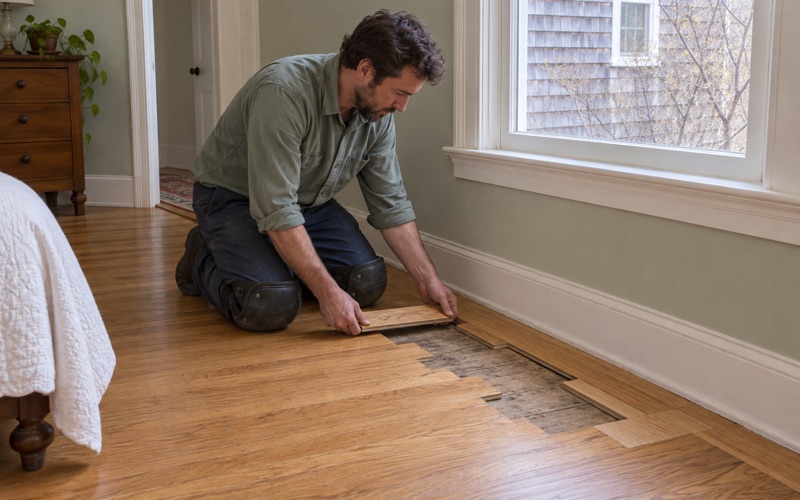
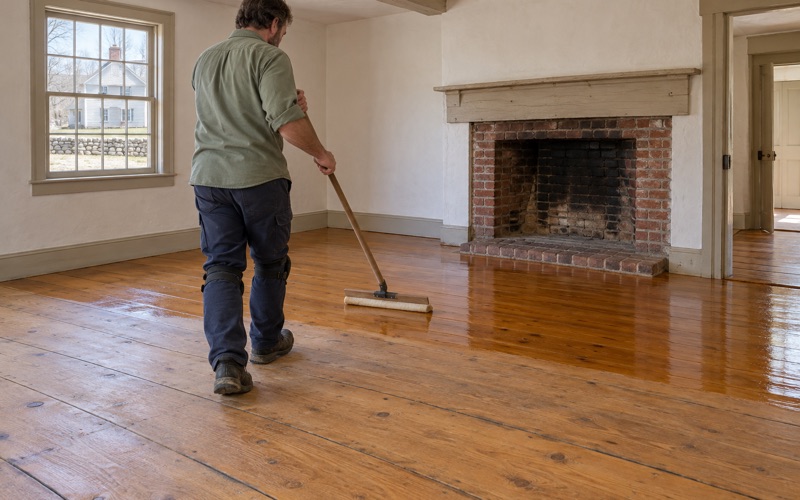
Where original oak, maple or pine boards remain, we repair and match them instead of tearing them out. A weave-in repair staggers new boards into the old field so the patch does not read as a rectangle. On wide plank pine we hunt for stock of similar width and grain, and we tell you when the closest match will still show.
Lead Paint and Pre-1978 Surfaces
Cochituate has plenty of housing old enough to raise the lead question. Of the village’s 2,572 housing units, 611, or 23.8 percent, were built in 1939 or earlier, according to the ACS 2024 five-year estimates for the census place. Because Massachusetts runs its own lead-safe renovation rules for homes built before 1978, we confirm the build year and check painted trim, baseboard and stair parts before sanding starts.
Painted quarter round, baseboard and stair risers sit right next to the sanding line. When those parts must come off or be sanded, we plan the work so dust stays contained, and a HEPA vacuum follows each pass.
Looking for wood-flooring closer to Braintree Town? See Wood-Flooring Services in Braintree Town.
Refinishing Cochituate’s 1940s and 1950s Houses
The next big layer of housing came after the war. The same census estimates count 286 units built in the 1940s and 557, or 21.7 percent, built from 1950 through 1959. Together with the prewar stock, 56.5 percent of the village’s units were built before 1960, so midcentury floors are a regular part of the work here.
Floors That Were Covered Up
Floors in many houses of that age were covered in later decades, first with carpet and then with vinyl or laminate. Pulling that back usually reveals tack strip holes along the walls, staple lines from carpet pad and sometimes black mastic from an old tile layer. Each of those changes how we prepare the surface, and we identify what we find before we quote the sanding.
Black mastic needs particular care, because older adhesives can contain asbestos and should not simply be sanded off. When we find it, we stop and talk through testing and removal before any drum sander touches that area.
Full Sanding or Screen and Recoat
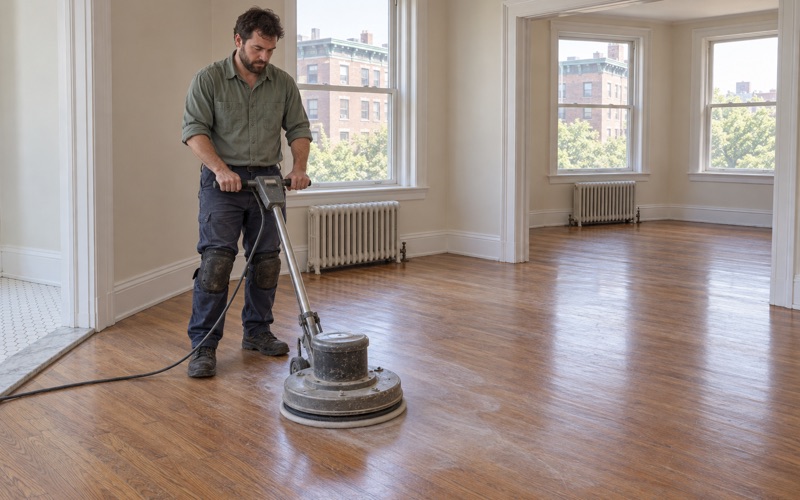
Not every floor needs to go back to bare wood. If the finish is worn but the wood beneath it is sound and the color is still wanted, a screen and recoat abrades the top coat with a buffer and adds fresh finish. It costs less, takes less time and removes almost no wood.
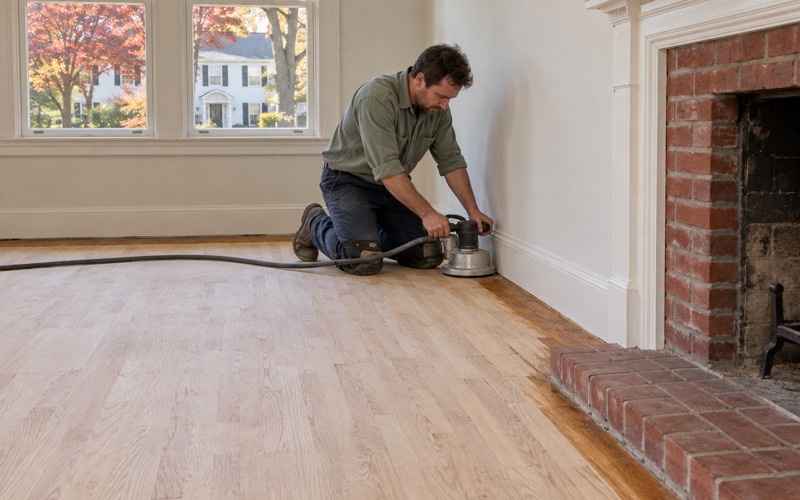
A full sanding makes sense for deep scratches, water stains, pet urine stains or a stain color the household no longer wants. We run a drum sander and an orbital sander through a grit sequence that suits the wood, fill gaps and nail holes with wood filler, and water pop the surface when a darker floor stain needs to take evenly.
Choosing a Finish
Finish choice comes down to look, durability and how long the rooms can sit empty. Waterborne polyurethane dries clear and cures faster, oil-modified polyurethane ambers the floor and takes longer, and a hardwax oil gives a low sheen that can be spot repaired. Every product we use fits the Massachusetts limits on VOC content in wood coatings, which are stricter than the federal ones.
We also settle the sheen level before the last coat. Satin hides everyday wear better than gloss, while matte suits wide plank pine and older rooms.
Owner-Occupied Homes Near Lake Cochituate and Dudley Pond
Most Cochituate homes are lived in by the people who own them. Of 2,432 occupied units, 2,082, or 85.6 percent, are owner-occupied, and one-unit detached houses account for 2,019 of the village’s 2,572 units. That means most of our projects here are planned around a household that often needs to keep living in the house while the floors are done.
Lake Cochituate and Dudley Pond both lie inside the census place, and we work on homes near both as well as in the older center of the village. The village counted 6,927 residents in 2020.
Working Room by Room
When a household is living at home, we split the job into zones. Furniture moves out of one set of rooms while the other set stays in use, and plastic barriers and a HEPA vacuum keep dust out of the living space. Dustless sanding cuts down cleanup, though no system removes every particle, so we still seal doorways and air returns.
The written cure schedule matters most here. It shows which rooms are off limits each day, when light foot traffic is safe and when rugs and furniture can go back, so meals, pets and bedtimes can be planned around it.
Seasonal Gaps and Humidity
Wood moves with the seasons in eastern Massachusetts. Heated winter air dries boards and opens winter gaps between them, while humid summers can push boards toward cupping or, in worse cases, crowning and buckling. Cochituate falls in National Weather Service forecast zone MAZ005, Central Middlesex County, which is the forecast we watch when timing finish coats.
Because of that movement, we take moisture meter readings before sanding or installing, and new boards go through acclimation in the house before they are nailed. Seasonal board gapping that closes again in summer is normal wood behavior and is rarely a reason to fill or replace boards.
Water Damage and Insurance Claims
Water stains and cupped boards near a steam radiator, a dishwasher or an upstairs bathroom need their source found before any repair. We trace the leak, dry the boards and read them with a meter until they settle, and we replace only what does not recover. When a claim is involved, we document the damage room by room for the adjuster.
Planning a Floor Project in Cochituate
A floor project here usually starts with a walk-through. We look at the species, the finish, the condition of the subfloor and any signs of past repairs, then check the build year and painted surfaces nearby. From there we write up the scope, the order of work and the cure schedule.
Stairs, Thresholds and Trim
Stairs are quoted by the tread and riser, not folded into a square-foot price, because each one takes its own sanding, edging and finish work. Worn stair nosing, loose treads and mismatched risers are common on older staircases, and we price repairs to each part separately. Reducers, thresholds and quarter round get the same attention where a refinished floor meets an older one.
Engineered Floors, Parquet and New Installation
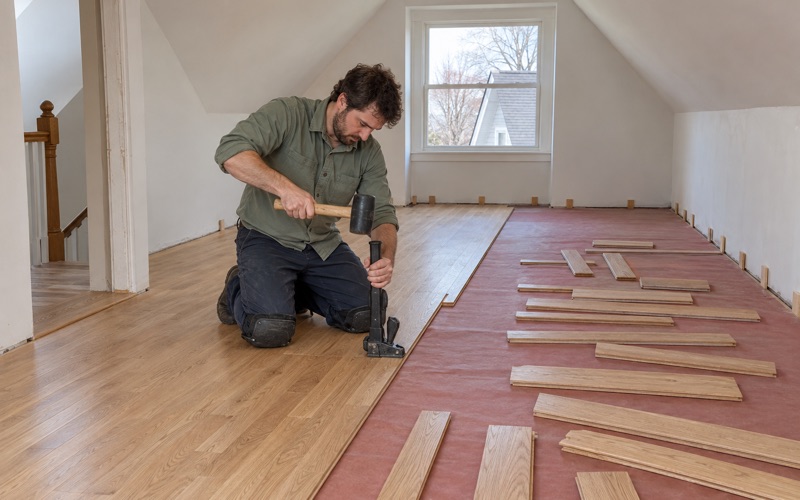
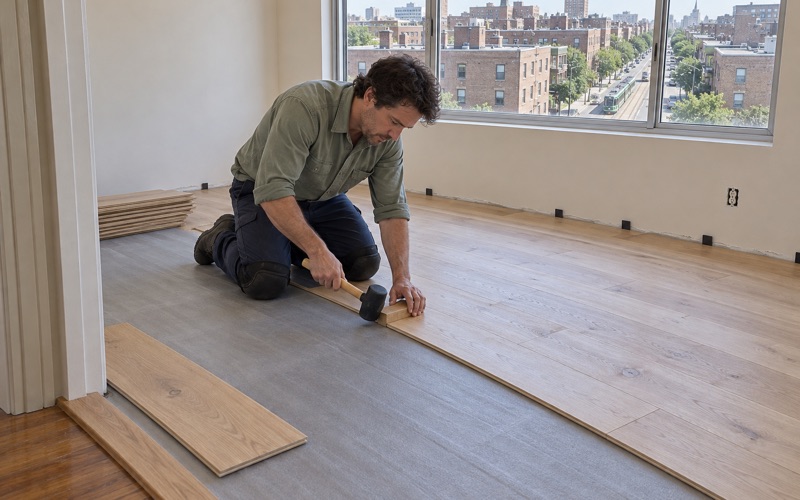
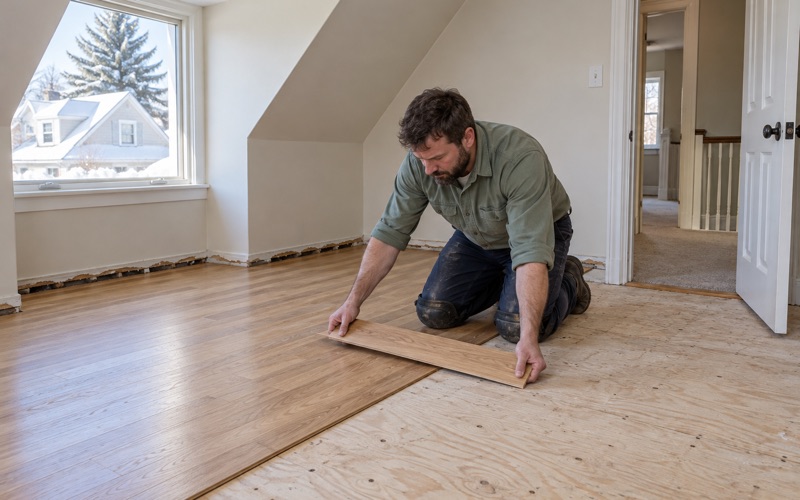
For engineered floors, we measure the engineered wear layer before we promise a sanding, since a thin layer may allow only a light pass or none at all. When a new floor is going in, we choose between nail-down, glue-down and floating installation based on the subfloor, the room and any radiant heat. We follow the NWFA Installation Guidelines on expansion gap, fasteners and acclimation.
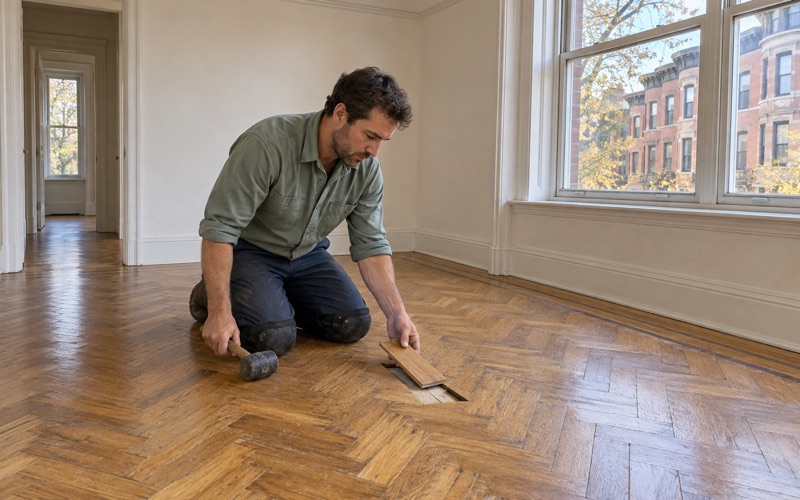
Where an older room has parquet or herringbone, we re-glue loose pieces and refinish them one by one rather than covering the pattern. If a tongue and groove board has split or a section shows powderpost beetle or carpenter ant damage, we handle it with board replacement matched to the surrounding floor.
- 20+ Years on Wood Floors
- Free In-Home Estimates
- Dust-Contained Sanding