Brookline Wood Flooring brings more than 20 years of hands-on work to wood-flooring in Dedham, and most of what we are called for here is sanding, repair and refinishing inside houses that have already carried several generations of furniture and foot traffic. A new floor goes down now and then, but the typical job is a tired one that still has good wood under it.
Before a sander comes off the truck, we confirm the year the house was built and look for painted surfaces the work could disturb, because Massachusetts sets its own lead-safe renovation rules for homes built before 1978. The finish we recommend is chosen to sit within the state limits on VOC content in wood coatings, which are tighter than the federal ones.
What follows is how that plays out in this town: the age of the housing, the historic districts around the village center, the two-family houses where a floor sits over a tenant, and the practical steps that keep a project on schedule. We have kept it to the questions homeowners actually ask us before a quote.
Floors in Dedham Houses Built Before 1940
An Older Housing Stock Than Most
Dedham was settled in 1635 and incorporated in 1636, and it serves as the Norfolk County seat. The houses reflect that long history. According to the Census Bureau’s 2024 five-year survey, 3,211 of the town’s 10,828 homes, or 29.7 percent, were built in 1939 or earlier, which makes the prewar group the largest single build bucket in town.
Taken further, 57.9 percent of Dedham homes predate 1960. In practical terms, more than half the floors we are asked to look at here belong to houses that have lived through six decades or more of heating seasons, and many have been sanded before. That history shapes every estimate, because the wood left above the tongue and groove decides what a floor can still take.
What We Check on a Prewar Floor
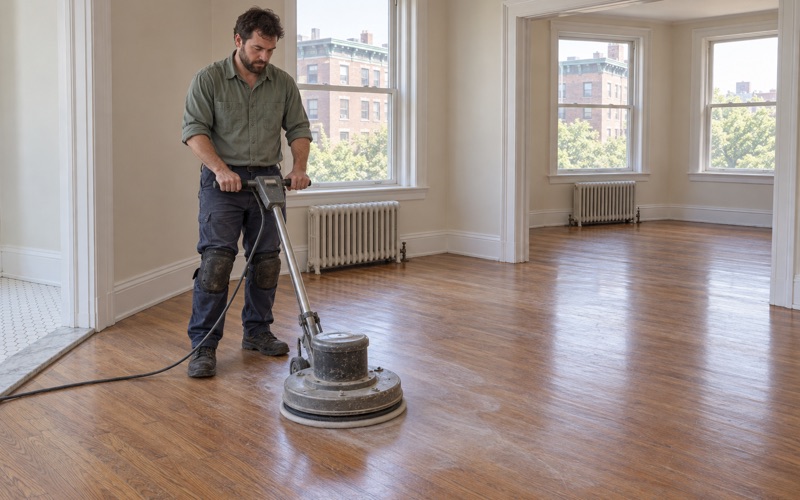
On an older solid hardwood floor we start by pulling a floor register or checking a threshold to see how much wood remains above the tongue. If a past sanding went deep, a heavy drum sander pass is the wrong tool, and a lighter grit sequence or a screen and recoat may be the honest answer. We also press along the boards for hollow spots and look for movement over the floor joists.
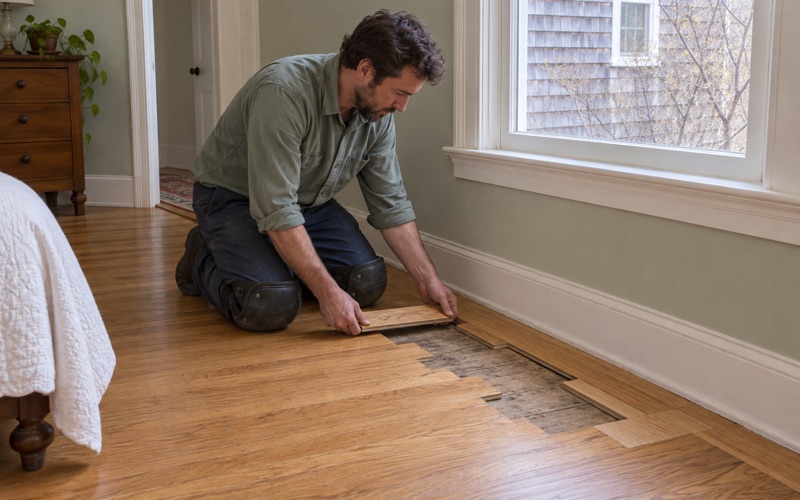
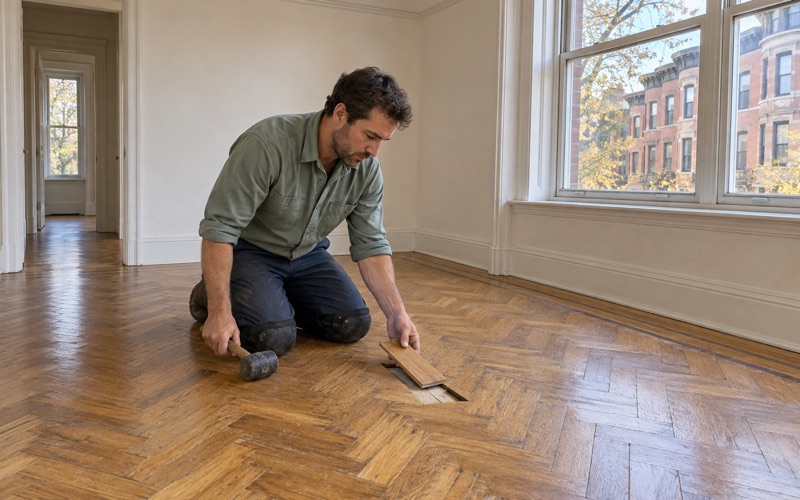
Old repairs tell a story as well. Patches in a different species, boards face-nailed where a radiator once stood, and dark water stains near a sink wall all show up once the finish is off. We repair and match original oak, maple and pine boards with a weave-in repair rather than tearing a room out, so the patch reads as part of the floor instead of a square cut into it.
The Postwar Layer
The second-largest group in town dates from the 1950s: 2,178 homes, or 20.1 percent of the housing count. Those houses usually give us a more uniform floor to work with than the prewar group, but they have their own habits, including carpet laid over wood for decades and tack strip nailed through the edges of the boards.
When carpet comes up in a 1950s house, we pull the tack strip and staples, fill the holes with a wood filler matched to the stain, and read the boards for pet urine stains that may have gone black under the pad. Some of those boards sand clean and some need board replacement. We say which is which before anyone commits to a stain color.
Looking for wood-flooring closer to East Boston? See Wood-Flooring Services in East Boston.
Working Inside a House in a Dedham Historic District
Three Local Districts
Dedham has three local historic districts: Connecticut Corner, Federal Hill and Franklin Square-Court Street. The Court Street-Franklin Square and Connecticut Corner districts also sit within the Dedham Village Historic District, listed on the National Register in 2006. Much of this area surrounds the village center that grew up around the county seat.
The Dedham Historic District Commission reviews exterior changes that are visible from a public way, and demolition is not permitted under normal circumstances. Fences are reviewed as well, while landscaping is not. That is the scope we can point to from the town’s published summary, and we do not speak for the commission beyond it.
Where Our Work Meets the Street
Floor refinishing happens indoors, but a floor project occasionally grows into something a neighbor could see from the sidewalk, such as a new exterior door with its threshold, or porch boards. When a job touches anything visible from a public way, we flag it early so the homeowner can take that part to the commission before it is scheduled, not after.
For questions about the process itself, the Town of Dedham Building Department at Town Hall, 450 Washington Street, handles building permits and inspections. We send homeowners there with the specifics of their job rather than guessing at an answer on the town’s behalf.
Protecting an Older Interior
Houses in and around the districts tend to have trim, doors and stair parts that are hard to replace. We remove quarter round and baseboard carefully, label it and set it back. Dust containment, a HEPA vacuum and plastic at the doorways keep sanding dust out of the rooms we are not working in, and a written cure schedule tells the household when each room is usable.
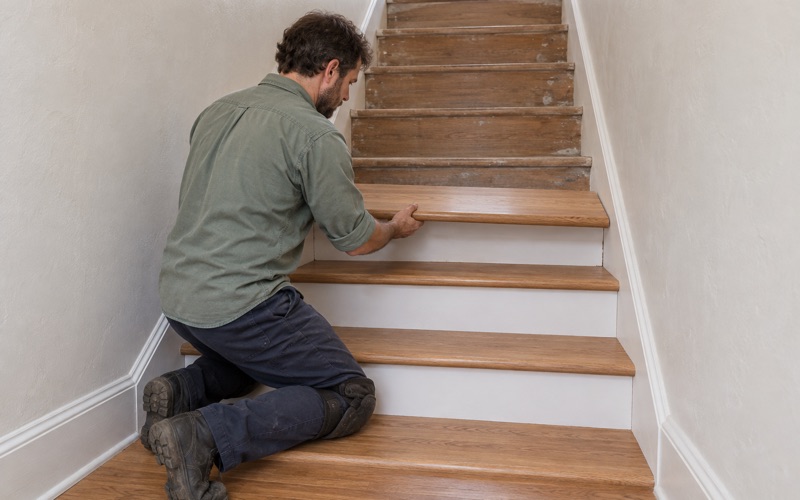
Stairs in these houses get their own attention. We quote stair treads and stair risers by the piece rather than folding them into a square-foot price, and a worn stair nosing is repaired or rebuilt to match the profile that is already there.
Two-Family Homes and Rented Units
A Town of Owners, With Tenants Upstairs
Of Dedham’s 10,530 occupied homes, 73.4 percent are owner-occupied. Still, 442 renter households live in two-unit buildings, more than the owner households in that same building type. Many of those are two-family houses where the owner lives on one floor and rents the other, and floor work has to fit around both.
That changes the schedule. A tenant’s unit usually needs to be clear of furniture and people for sanding and the first coats, so we set dates with the owner early and hand over a written plan that can go to the tenant. A floor finished between leases is the easiest version of this job, and we will plan backward from a move-out date when that is possible.
Floors Over a Neighbor
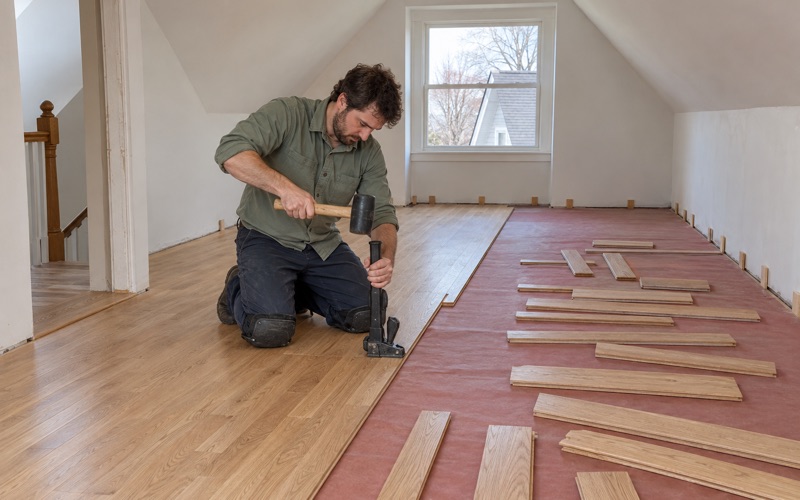
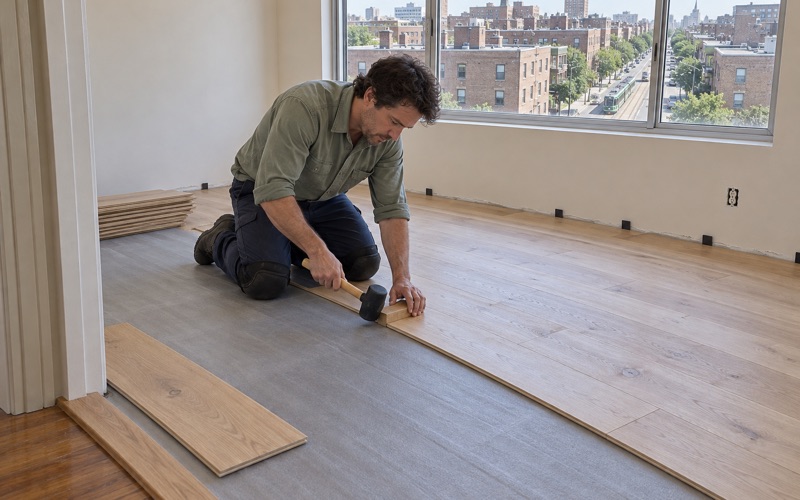
When the floor sits above another household, sound matters more than it does in a single-family house. If a unit is getting a new floor, we choose the underlayment with the building’s sound or rug-coverage rules in mind, and an acoustic underlayment under a floating installation is one option we talk through along with nail-down and glue-down methods.
In a condo conversion or any building with an association, the rules come first. We confirm the association’s flooring rules, working hours and elevator booking before a unit goes on the calendar, so the crew is not turned away at the door on day one.
Leaks Between Floors
In a stacked house, water from an upstairs bathroom or a steam radiator valve shows up as cupping or crowning in the boards below, sometimes weeks after the leak. We find the source first, then dry the area and read the boards with a moisture meter before anything is sanded or replaced, because sanding a cupped floor too early leaves it crowned once it dries.
If an insurance claim is involved, we document the water damage room by room for the adjuster, with moisture readings and photos, so the owner and the tenant are not left arguing over which room was affected.
Planning a Floor Project in Dedham
Reading the Floor Before the Quote
Every estimate starts in the house. We check the species, whether the floor is solid hardwood or engineered, and on an engineered floor we measure the wear layer before promising a sanding. We look at board gapping, buckling near exterior walls, and any sign of powderpost beetle or carpenter ants where subfloor or plank subfloor is exposed.
Prewar parquet deserves its own mention. Where loose herringbone or block parquet has lifted, we re-glue and refinish it piece by piece rather than covering it with a new floor, which keeps the pattern that made the room worth keeping in the first place.
Seasons and Winter Gaps
Dedham falls in the National Weather Service forecast zone MAZ013, Western Norfolk. Like the rest of eastern Massachusetts, it sees dry, heated winters and humid summers, and wood floors move with that. Winter gaps that open between boards in January often close again by summer, and we explain that before anyone asks us to fill them.
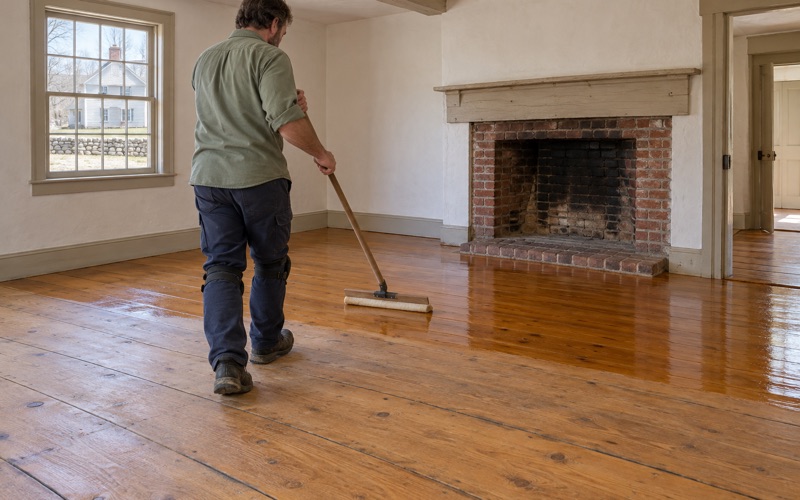
Timing matters for the finish too. Waterborne polyurethane and hardwax oil each behave differently in cold, dry air than in summer humidity, so we set the cure schedule by the season and the product, and we let new boards go through acclimation in the house before a nail-down installation begins.
What to Expect on the Day
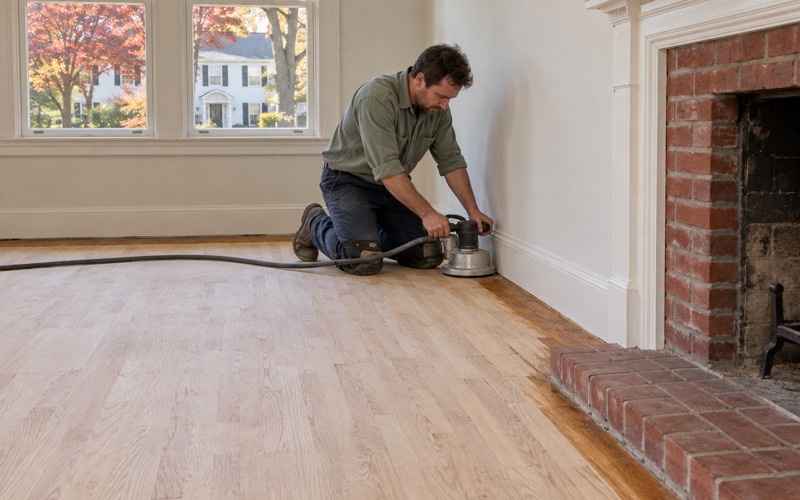
A typical refinishing job runs through moving furniture out, sanding with a drum sander and an orbital sander at the edges, water popping if the stain calls for it, then floor stain and the coats of finish at the sheen level the homeowner picked. We leave written instructions for the first days of use, including when rugs and furniture can come back.
When the work is done, the goal in a house this age is simple: a floor that looks like it belongs to the building, repaired where it needed repair, and ready for decades more use. We walk the rooms with the homeowner before we leave so any small detail is fixed while the crew is still on site.
- 20+ Years on Wood Floors
- Free In-Home Estimates
- Dust-Contained Sanding