
Brookline Wood Flooring installs and refinishes engineered hardwood flooring in Brookline, MA, serving surrounding cities including Jamaica Plain, Forest Hills, West Roxbury, Watertown and Back Bay. With 20+ years on wood floors, we put engineered hardwood where solid wood struggles: over radiant heat, on concrete, in basements and in condo units where the building’s sound rules shape the floor assembly. We also refinish and repair engineered floors, measuring the wear layer before we promise anything.
Engineered hardwood has a real wood surface bonded to a layered core, which makes it far more stable than solid boards when moisture or temperature changes. In older homes around Brookline, that stability matters in kitchen renovations with radiant heat, finished basements and condo units being updated on concrete slabs or over thin subfloors.
The products vary widely, though. The thickness of the wear layer, the quality of the core and the finish all decide how long the floor lasts and whether it can ever be sanded. We help you compare engineered products by what is inside them, not only by the sample on top.
Understanding Engineered Hardwood
The Wear Layer and the Plywood Core
Every engineered board has two parts: the engineered wear layer, a slice of real hardwood on top, and a plywood core made of layers glued with their grain crossing. The crossing layers resist the swelling and shrinking that make solid wood move. The wear layer is what you walk on, and its thickness decides how many times the floor can be sanded and refinished.
Thin wear layers keep the price down but may never be sanded. Thicker ones can be refinished like solid wood, sometimes more than once. We show the thickness on every sample so the comparison is fair.
Surfaces, Species and Edge Profiles
Engineered hardwood comes in the same species as solid flooring, including red oak, white oak, maple and hickory, in widths that are hard to buy as solid boards. Most products are prefinished at the factory, with a small beveled edge between planks. Some are sold unfinished so they can be site-finished and sanded flat after installation for a seamless surface.
Wider planks and longer lengths are one of engineered flooring’s strengths. The stable core lets a wide plank stay flat where a solid board of the same width would cup.
Engineered Versus Solid Hardwood
Solid hardwood is a single piece of wood that can be sanded many times and suits most rooms above grade on a wood subfloor. Engineered hardwood is the better choice over concrete, radiant heat and below grade. Where both would work, the choice comes down to budget, width, sanding life and the look you want.
In older homes with original solid floors, we often recommend refinishing what is there instead of either. Engineered flooring makes the most sense where there is no wood floor to save.
Where Engineered Hardwood Works Best
Over Radiant Heat
Radiant heating dries the floor from below and cycles it through temperature changes every day of the heating season. Solid boards shrink and gap under that stress, while engineered boards stay much steadier. Manufacturers publish specific instructions for radiant systems, including maximum surface temperatures and how to bring the system up to heat after installation.
We confirm the heating system type and those instructions before ordering, and we coordinate with your heating contractor on start-up so the new floor is not shocked in its first week.
Over Concrete and in Basements
Concrete slabs give off moisture, and basements sit below grade where the air is damper than the rooms above. Solid hardwood cannot tolerate either. Engineered hardwood installed floating over a moisture barrier, or glued down with an adhesive that blocks moisture, is the wood floor that works there.
We test the slab for moisture before anything is ordered. If readings are too high, we tell you, because a wood floor over a damp slab will cup no matter how it is installed.
Condo Units and Acoustic Underlayment
In condo buildings, engineered hardwood is often the practical choice for units on concrete floors or with limited subfloor height. Many associations, under rules authorized by M.G.L. c.183A, set rug-coverage requirements or require an acoustic underlayment beneath hard floors. We read your building’s documents before quoting and choose an underlayment and installation method that meet them.
Installation Methods for Engineered Floors
Glue-Down Installation
In a glue-down installation, each plank is bonded to the subfloor or slab with adhesive spread by trowel. It gives a solid feel underfoot and less hollow sound, which suits condos. Many adhesives also act as a moisture barrier over concrete. The subfloor must be flat and clean, since the floor will follow every dip.
Floating Installation
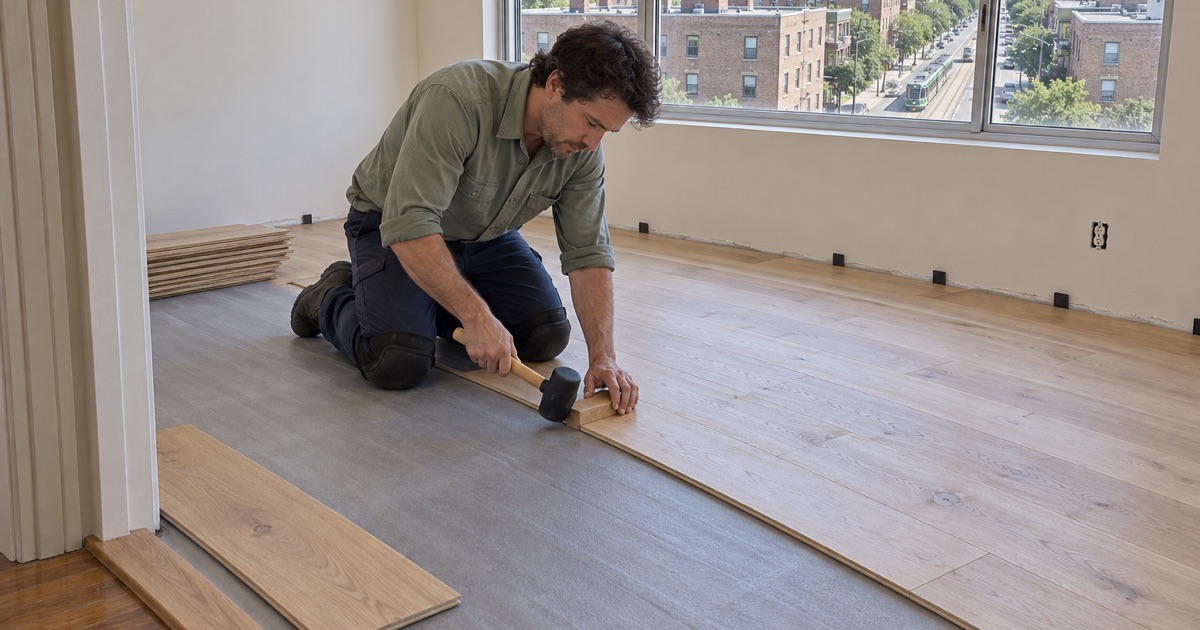
A floating installation connects planks to each other, by locking edges or glue in the joints, and lays the floor over an underlayment without fastening it down. It is faster, works over many existing hard surfaces and can be removed later. It needs a flat subfloor and a proper expansion gap around every wall.
Nail-Down and Staple-Down Over Wood
Over a wood subfloor, thicker engineered boards can be installed with a flooring nailer using cleats or staples, much like solid hardwood. This method suits upper floors in houses with sound plank or plywood subfloors, and it gives the firmest feel of the three.
Refinishing and Repairing Engineered Floors
Measuring the Wear Layer Before Sanding
Before we sand any engineered floor, we measure the wear layer at a floor vent, a threshold or a removed plank. If there is enough wood, we sand it with light passes and finer grits to take off as little as possible. If there is not, we recommend a screen and recoat instead, rather than risk sanding through to the plywood core.
Screen and Recoat for Engineered Floors
When the factory finish is dull but intact, a screen and recoat can renew it without touching the wood. Some factory finishes resist new coats, so we test adhesion first. When the test passes, a recoat is often the best way to extend the life of a thin wear layer.
Replacing Damaged Planks
Damaged planks from water, pets or impact can be cut out and replaced with matching planks. On floating floors, planks near a wall can sometimes be unlocked and swapped. We always suggest keeping a box of spare planks after installation, since product lines change and an exact match can be hard to find later.
Our Step-by-Step Engineered Hardwood Installation Process
Step 1: Assess the Subfloor and Heating
We check the subfloor type, flatness and moisture, confirm any radiant heat, and review condo rules. That tells us which products and installation methods are suitable.
Step 2: Choose the Product
We compare samples by wear layer, core, width and finish, then order enough for waste and spares. The flooring is delivered to acclimate as the manufacturer requires.
Step 3: Prepare and Install
The subfloor is flattened, barriers and underlayment go down, and planks are glued, floated or nailed. Expansion gaps, transitions and trim are fitted as we go.
Step 4: Walk Through and Care
We clean the floor, walk it with you and hand over care instructions and spare planks. For radiant systems, we go over the start-up schedule once more.
- 20+ Years on Wood Floors
- Free In-Home Estimates
- Dust-Contained Sanding