
Brookline Wood Flooring works on hardwood stairs in Brookline, MA, serving surrounding cities including Jamaica Plain, Forest Hills, West Roxbury, Watertown and Back Bay. With 20+ years on wood floors and stairs, we refinish treads, risers and nosings, convert carpeted stairs to hardwood, replace worn and split treads, and match the finish to the floors at the top and bottom of the flight.
Stairs are the most hand-worked part of any floor job. Each step has a flat tread, a vertical riser and a rounded nosing, and each has to be sanded separately with detail sanders and scrapers because a large floor machine will not fit. That is why we quote stairs by the tread and riser rather than folding them into a square-foot price, so you see exactly what the staircase costs.
Older homes add their own questions: painted risers that may contain lead, treads worn into dips by a century of footsteps, and carpet covering treads that were never meant to be seen. We answer those before quoting, so the price reflects the actual staircase.
Refinishing Hardwood Stairs
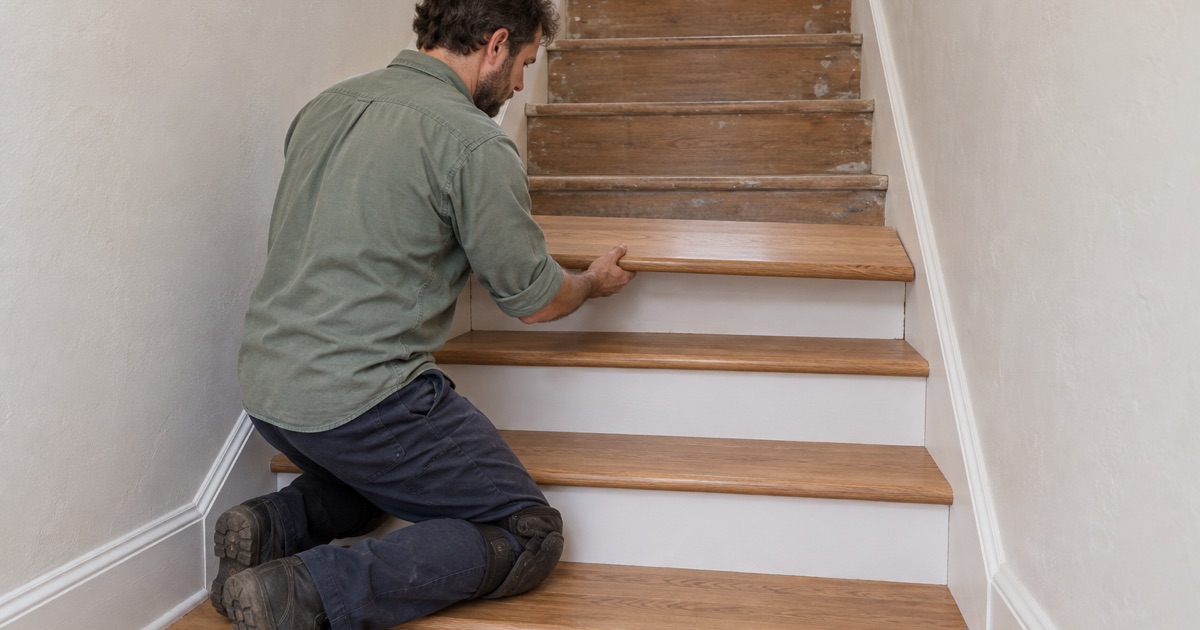
Treads, Risers and Nosings Sanded by Hand
Every stair tread is sanded with a small sander and finished at the edges and corners by hand scraping, because the space against the stringer and the riser is too tight for a machine. The stair nosing, the rounded front edge, is shaped by hand so it keeps its profile. Risers are sanded or, if painted, handled separately.
After sanding, the treads get the same stain and finish as the floor. Treads take more wear than almost any other part of a house, so we often recommend an extra coat of finish on them.
Painted Risers and Stringers
Many older staircases have stained oak treads with painted risers and stringers, a classic look worth keeping. We protect the painted parts while the treads are refinished and repaint them afterward if needed. When risers are to be stripped to wood instead, we confirm first that the paint is safe to disturb.
Converting and Replacing Stair Treads
Carpet to Hardwood Stair Conversion
Converting a carpeted staircase starts with removing the carpet, pad, tack strip and staples. If the treads beneath are finished hardwood, they are repaired and refinished. More often they are rough construction treads, so we install new hardwood treads and risers over them or replace them, with a proper nosing on each step.
New treads are chosen to match the floor at the top and bottom of the stairs. Red oak and white oak are the usual choices, and they can be stained to blend with an older floor.
Replacing Split, Loose and Squeaky Treads
A tread that is split, loose or squeaking has usually lost its fastening to the stringer or has a crack along the grain. We refasten or glue loose treads and replace split ones with matching wood. A replaced tread is sanded and finished with the rest so it does not stand out.
Squeaks on stairs usually come from a tread rubbing on its riser or on a loose wedge beneath it. Where the underside of the staircase is open, we glue and block the joint from below, which silences the step without a single visible fastener on top.
Stair Nosing at Landings and Floor Edges
Where a floor meets the top of a staircase or a landing, a stair nosing finishes the edge. When new flooring goes in, the landing nosing often has to be replaced so its height and profile match the new boards. We fit landing nosings to the exact floor thickness so there is no lip to catch a toe.
The same care goes into the skirt boards that run along the side of the stairs and the base of each baluster. New treads are scribed to fit tight against an old skirt board that is rarely straight, so the joint stays clean without a bead of caulk to hide a gap.
Stairs in Older Houses
Lead Paint and the Massachusetts Lead Law
In homes built before 1978, painted stairs may contain lead. Massachusetts runs its own lead-safe renovation rules under 454 CMR 22.00, which bar power sanding of painted surfaces without HEPA-filtered exhaust. Where a child under six lives, the Massachusetts Lead Law requires stair treads to be abated entirely or covered. We check build year and paint before any work begins.
Worn, Dished Treads in Century-Old Staircases
In older homes, a hundred years of footsteps can wear the center of each tread into a shallow dish. Light wear sands out. Deep dishing may mean the tread is too thin to sand further safely, and replacing it with a matched tread is the better choice. We check thickness at the back of each tread before deciding.
Back stairs in older two-families and Victorians are often a different story from the main staircase: narrower, steeper and built of pine rather than oak. Those treads wear faster and dent more easily, and we treat them gently, sanding lightly and choosing a finish that stands up to daily traffic.
Pricing and Matching Stairs to Floors
Quoted by the Tread and Riser
Our stair quotes list the number of treads, the number of risers, the landing nosings and any repairs separately. That makes it easy to compare with other estimates and to see what refinishing the stairs costs on its own versus with a whole floor.
A straight flight, a winding staircase with pie-shaped winder treads and a stair with open returns on one side all take different amounts of hand work. Listing each step type in the quote keeps a curved or open staircase from being priced like a simple closed flight.
Matching Stain and Finish Between Floors and Stairs
Stairs connect two floors, so a mismatch in color or sheen shows at the top and the bottom. We finish stairs with the same product and stain as the floors they join, and test the stain on a tread first because stair wood is sometimes a different species or cut than the floor.
- 20+ Years on Wood Floors
- Free In-Home Estimates
- Dust-Contained Sanding