
Brookline Wood Flooring works on parquet flooring in Brookline, MA, serving surrounding cities including Jamaica Plain, Forest Hills, West Roxbury, Watertown and Back Bay. With 20+ years on wood floors, we re-glue and refinish prewar parquet block by block, replace missing pieces with matched wood, and install new herringbone and chevron floors in oak and maple.
Parquet is common in the brick apartment and condo buildings built along the trolley lines before the war, and much of it is still in place under rugs, carpet and decades of finish. Those floors are often worth saving. The blocks are solid wood, the patterns are hard to reproduce at the same cost today, and a careful refinish brings them back without raising the floor or losing the original design.
The work is slower than refinishing a strip floor, because the grain runs in several directions and loose blocks have to be reset first. We quote parquet on its own terms, with repairs listed separately, and take the time the pattern requires.
Refinishing Prewar Parquet
Re-Gluing Loose Parquet Blocks
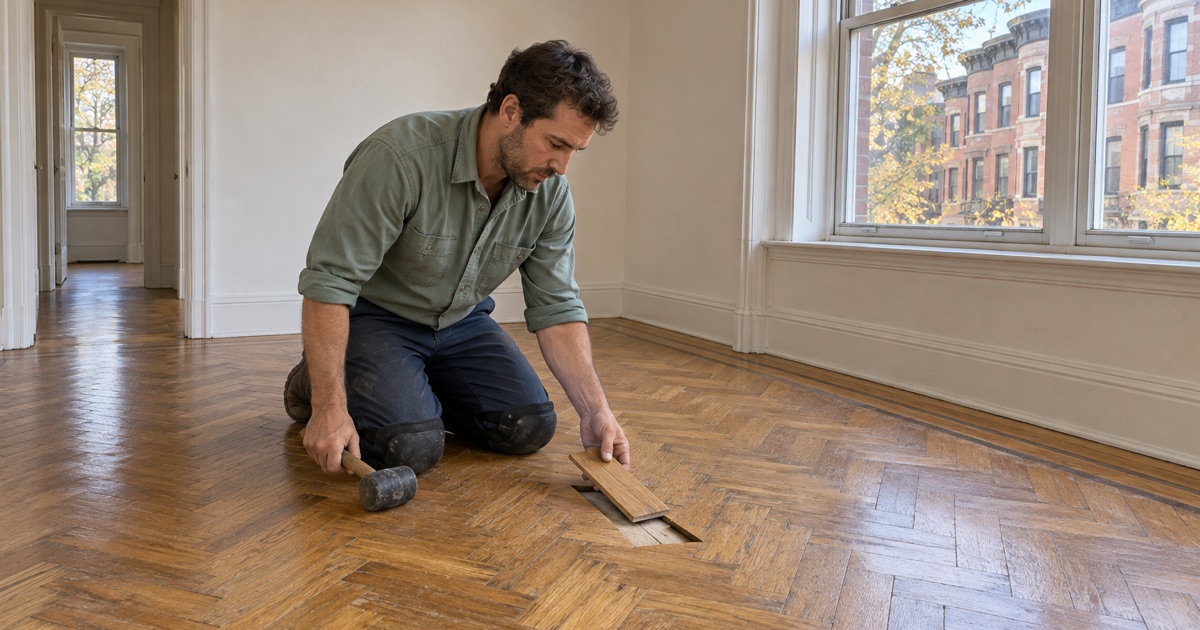
Old parquet was set in mastic that dries out over decades and releases its grip, especially near radiators or after a leak. Loose blocks click, rock or lift at the corners. We lift each loose piece, clean the old adhesive from the block and the subfloor, and re-glue it so it sits flat and tight to its neighbors.
Re-gluing always happens before sanding. A loose block under a sander tears out or sands unevenly, leaving a low spot that shows in the finished floor.
Sanding Across Several Grain Directions
Parquet runs its grain in two or more directions within every square foot, so any sanding pass cuts across the grain of some pieces. We sand at angles to the pattern with a drum sander, then work the whole floor with an orbital sander to remove cross-grain scratches and swirl marks. Finer grits at the end keep the pattern crisp under the finish.
This extra work is what separates a parquet floor that looks refinished from one that looks scuffed under new polyurethane. It is also why we price parquet refinishing separately from strip flooring.
Finishes for Parquet Floors
Most prewar parquet is oak, sometimes mixed with darker woods at the borders. A clear waterborne polyurethane keeps the contrast between pieces visible, while a stain tends to blur it. We test stains on a hidden area first, because each block takes color slightly differently depending on how its grain faces up.
Repairing Damaged Parquet
Replacing Missing and Broken Blocks
Missing or broken blocks are common where radiators, walls or cabinets have been moved. We match replacements by species, size and grain orientation, cutting pieces from salvaged parquet or new stock as needed. Each replacement is glued in and sanded level with the pieces around it.
When a pattern has a border or a decorative inlay, we take extra care to rebuild it exactly, since a mistake there is the first thing a visitor notices. Contrasting border woods are matched by color after finish, not only by species.
Water and Pet Damage in Parquet
Water lifts parquet quickly, because the small blocks swell and release their adhesive together. After the floor dries, some blocks settle back and can be re-glued, while blackened or split pieces are replaced. Pet urine turns oak parquet black, and those blocks are replaced rather than sanded, since the stain runs deeper than a sanding reaches.
Black Mastic Beneath Old Parquet
Older parquet was often laid in black mastic, and some older black adhesives contain asbestos. It is safe while intact under the floor. Before any sanding reaches it or any block is scraped clean, we have it tested by a qualified lab, and we plan the repair or removal around the result.
Herringbone and Chevron Floors
Herringbone Patterns in Oak and Maple
Herringbone lays rectangular boards in a zigzag, with the end of each board meeting the side of the next at a right angle. It suits living rooms, entries and hallways, and it makes a narrow room feel wider when the pattern runs across it. We install herringbone in red oak, white oak and maple, site-finished so the joints are sanded flat and sealed.
Laying the pattern starts with a straight, square center line, since a small error at the start grows across the room. We plan the layout on paper and on the floor before the first board goes down.
Chevron Floors
Chevron uses boards with their ends cut at an angle, so they meet in a continuous point down the room rather than the stepped look of herringbone. It is more formal and needs precisely cut boards. Engineered chevron boards with a plywood core are also available for use over concrete or radiant heat.
Pattern Borders and Transitions
A border of straight boards around a herringbone or chevron field frames the pattern and handles uneven walls. We set borders at doorways and hallways so the pattern stops cleanly, and fit thresholds and reducers where parquet meets tile or another floor.
Parquet in Condo Buildings
Association Rules and Sound
Many parquet floors sit in condo buildings where the association sets rules on work hours, elevator use and, for new floors, underlayment and rug coverage. We confirm those before scheduling. Refinishing existing parquet does not change what the neighbors below hear, which makes it an easy choice in a building with strict flooring rules.
Refinishing Instead of Covering Over
A common suggestion for tired parquet is to cover it with a floating floor. That raises the floor at every doorway, can conflict with a building’s underlayment rules and hides a solid wood floor that could still be refinished. Re-gluing and refinishing is usually the better option, and we explain the trade-offs honestly.
- 20+ Years on Wood Floors
- Free In-Home Estimates
- Dust-Contained Sanding