
Brookline Wood Flooring handles pine floor refinishing in Brookline, MA, serving surrounding cities including Jamaica Plain, Forest Hills, West Roxbury, Watertown and Back Bay. With 20+ years on wood floors, we refinish wide plank pine, eastern white pine and antique heart pine with lighter machines, finer grits and finishes chosen to keep the wood from turning orange again. We treat pine as its own material, not as soft oak.
Pine floors turn up in the oldest houses around Boston, from farmhouses and Federal-era homes to the back rooms, kitchens and upper floors of Victorians where pine was used instead of oak. Many of those floors have been painted, carpeted, sanded hard and sanded again. What is left is usually still worth saving, because boards of that width and age cannot be bought at a lumberyard.
The usual questions are the same ones each time: whether the floor is worth it, what to do about the gaps, and how to get rid of the orange. We answer them at the estimate with the floor in front of us, and we tell you plainly if a board or a section has reached the end of its life.
Sanding Pine Without Losing the Floor
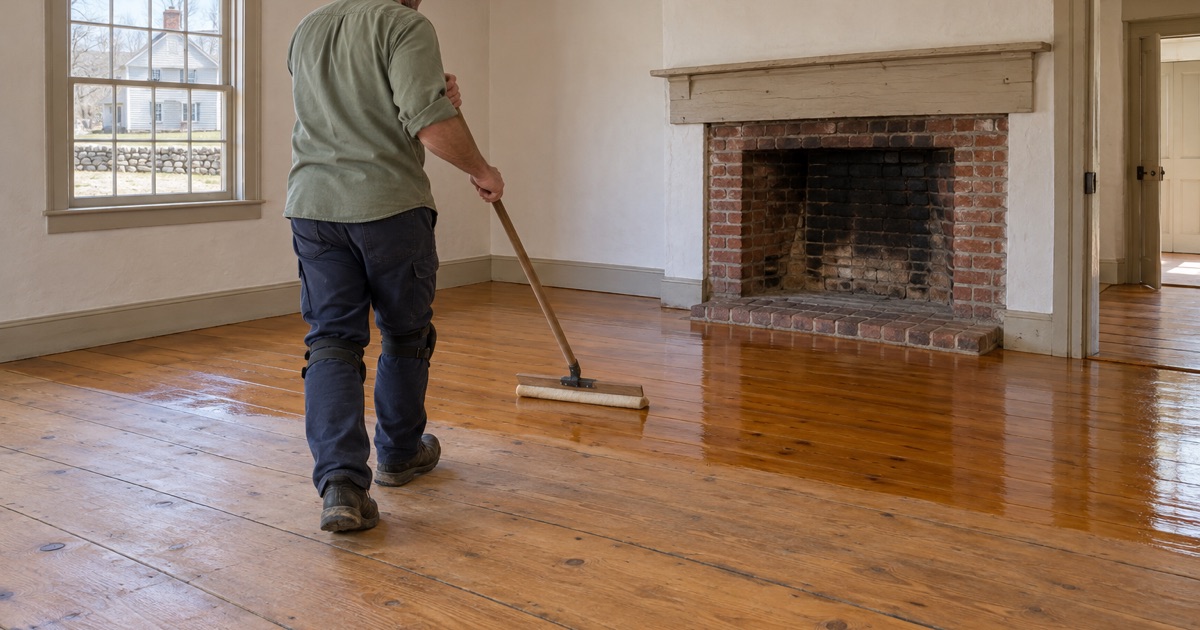
Lighter Machines and Finer Grits
Pine is soft, with a low Janka hardness, and a heavy drum sander with coarse paper can cut into it quickly and leave waves across the boards. We use lighter passes, start at a finer grit than we would on oak and let the machine do less work per pass. The goal is to remove the old finish and the worst wear while keeping as much wood as possible.
On very old or uneven wide plank floors, some boards are cupped or worn into hollows that a machine would chase too far. We hand scrape those boards so the floor keeps its character without being flattened into something it never was.
Checking Board Thickness First
Before we sand, we look at board thickness at a floor vent, a threshold or a lifted board. Pine floors that have been sanded several times in the past may have little wood above the tongue, and face nails may sit close to the surface. We set nails deeper where needed and adjust the sanding plan to the wood actually left.
Painted Pine Floors
Many pine floors were painted at some point, sometimes several times. In a house built before 1978, that paint is presumed to contain lead until tested, and Massachusetts lead-safe renovation rules bar power sanding it without HEPA-filtered exhaust. We check build year and test or treat the paint as lead before any removal, then refinish the wood underneath.
Gaps, Cracks and Worn Boards
Wide Gaps Between Old Boards
Wide plank pine shrinks across its width, and old floors often have gaps between boards large enough to catch crumbs. Some gaps open and close with the seasons, widening in the dry heating months and narrowing in summer. Others are permanent. We tell you which is which before deciding whether to fill anything.
Permanent gaps can be filled with thin slivers of pine glued into the joint, which move with the boards. Seasonal gaps are best left open, because wood filler pressed into them cracks out when the boards swell again.
Replacing Split and Worn-Through Boards
Pine splits along the grain and wears through at doorways and in front of stoves and sinks. When a board is too thin or too split to keep, we replace it with pine of matching width and age, often reclaimed stock. Where an exact match cannot be found, we borrow a board from a closet or under a built-in and put the new wood in the hidden place.
Taking the Orange Out of Pine
Why Old Pine Turns Orange
Pine darkens naturally with light and age, and oil-based finishes applied decades ago amber heavily on top of it. Together they produce the orange or pumpkin tone that makes many pine floors look dated. Sanding removes the aged finish and some of the darkened surface, which is most of the problem.
Finishes That Keep Pine Pale
A clear waterborne polyurethane adds very little color, so pine finished with it stays close to its freshly sanded tone. Hardwax oil gives a matte, natural look that suits wide plank floors and can be spot repaired later. Both options are used within the Massachusetts limits on VOC content in wood coatings under 310 CMR 7.25.
If you want the warmer look of an old pine floor, an oil-modified finish gives it deliberately. We show each option on a sample board in your room so you can choose by eye.
Staining Pine Evenly
Pine takes stain unevenly, soaking it up in soft areas and resisting it in harder growth rings, which can leave a blotchy floor. When a color change is wanted, we water pop or condition the wood first and test the floor stain on the floor itself. Many owners decide against stain once they see the sanded pine.
Living With a Refinished Pine Floor
Dents, Wear and Sheen Level
A refinished pine floor will still dent under a dropped pan or a chair leg, because the finish protects the surface but cannot make the wood harder. A matte or satin sheen level hides small dents and scratches far better than gloss. Felt pads, entry rugs and a quick sweep of grit go a long way.
Maintenance and Recoats
Pine finished with polyurethane can be kept fresh with a screen and recoat before the finish wears through, which avoids another full sanding and preserves the wood. Hardwax oil floors are refreshed by cleaning and re-oiling the worn areas. Either way, catching wear early is what keeps an old pine floor going for another generation.
- 20+ Years on Wood Floors
- Free In-Home Estimates
- Dust-Contained Sanding