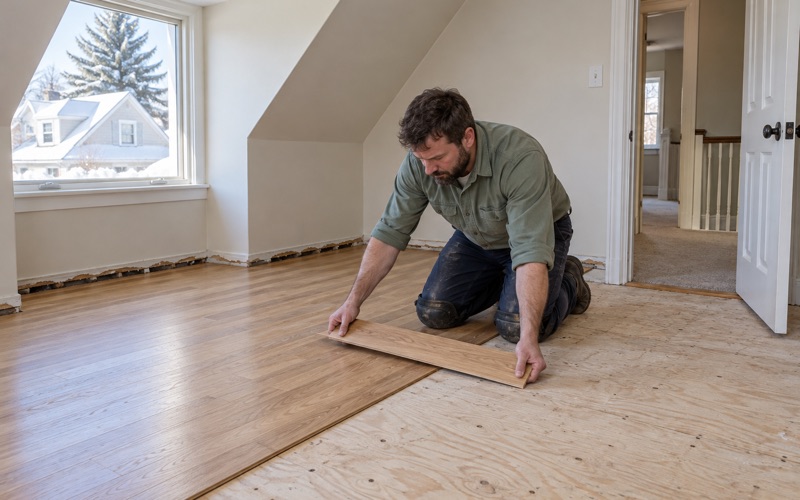
Brookline Wood Flooring has handled wood-flooring in Wellesley and across the region for more than 20 years, and most of that work starts the same way: we look at the house before we look at the floor. The build year tells us what sits under the finish, whether lead rules apply, and how much sanding the boards can still take.
In this town that range is wide. Some jobs are a full sanding and refinish on boards in houses that have stood for close to a century, and others are a first recoat on a floor laid within the last two decades. We quote each one on what the floor actually is, not on a flat rate per room.
Every visit ends with a written plan: the grit sequence or recoat method, the finish, the dust containment we will set up, and a cure schedule showing when furniture, rugs and pets can come back. That schedule is what lets a household keep living in the house while one floor at a time is out of service.
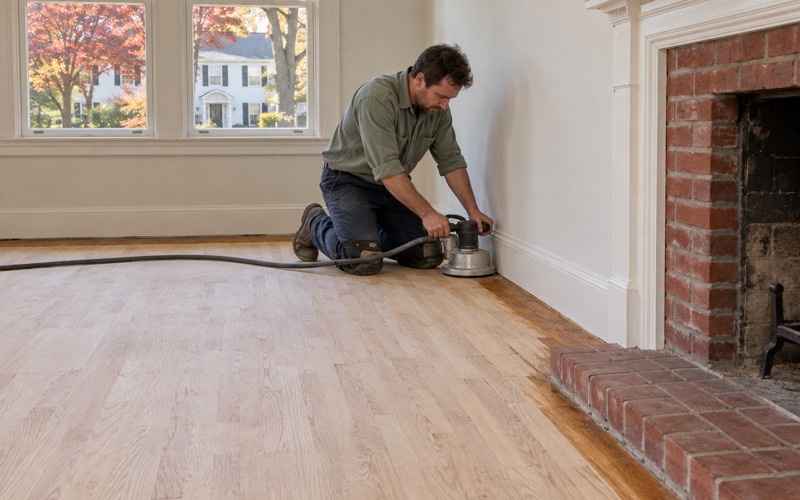
Refinishing Floors in Wellesley Houses Built Before 1950
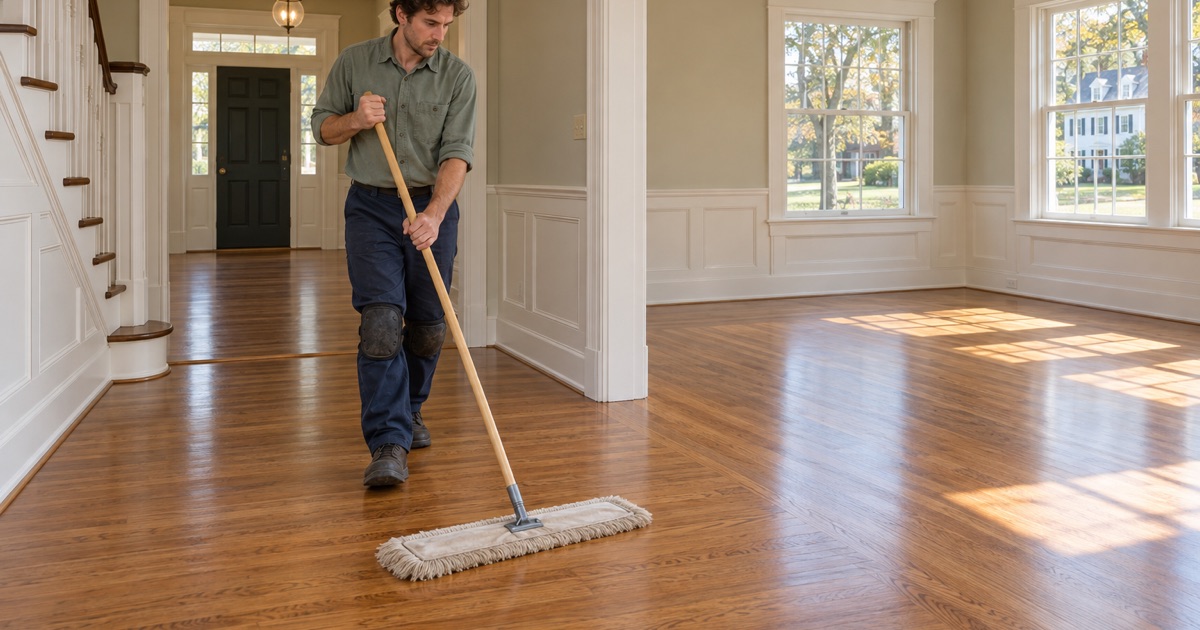
The census count makes the case for how much of this work is restoration. Of Wellesley’s 9,400 housing units, 3,170, or 33.7 percent, were built in 1939 or earlier, according to the ACS 2024 five-year estimates (table B25034). Another 925 went up between 1940 and 1949, so a large share of the town’s houses predate 1950.
Reading the Boards Before Any Sanding
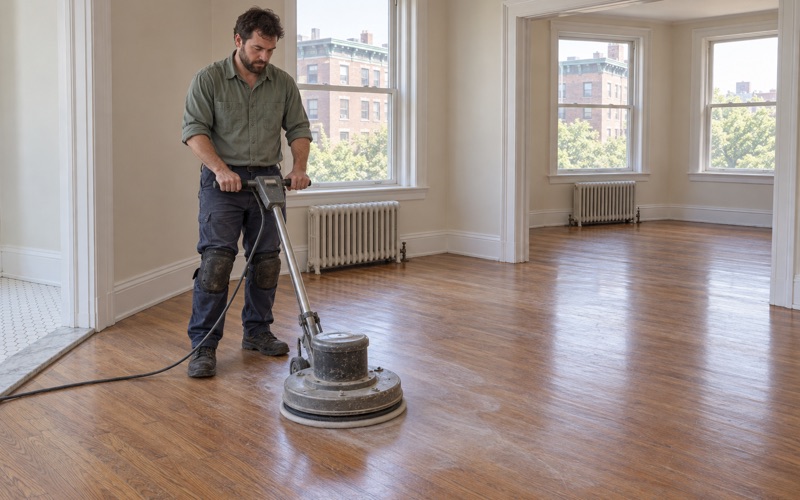
Older floors have usually been sanded before, sometimes more than once, and each pass reduces the wood left above the tongue. We check board thickness at a floor register or threshold, look for hollow spots, board gapping and old face nails, and note any cupping or crowning that points to moisture from below. Those readings decide the grit sequence, and whether a full sanding is wise at all.
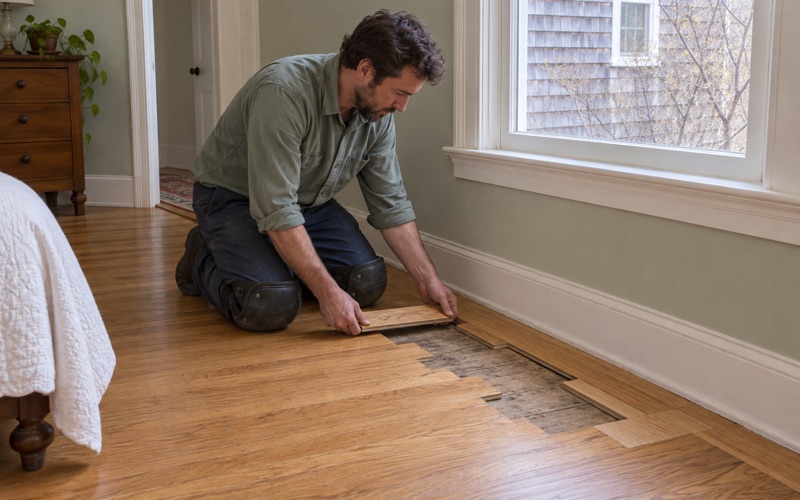
Where a board is split, stained black by pet urine, or damaged by powderpost beetle or carpenter ants, we cut it out and weave in a replacement rather than tearing up the room. Whether the original boards are oak, maple or pine, we match species, width and grain as closely as the stock allows, then sand the repair and the old floor together so they finish as one surface.
Lead Paint and the Finish That Goes Back Down
Every house built before 1950 also falls well inside the pre-1978 window that Massachusetts treats separately under its own lead-safe renovation rules. We confirm the build year and look at painted baseboards, stair risers and thresholds before any sanding starts, because a drum sander run into painted trim is exactly the dust those rules exist to prevent.
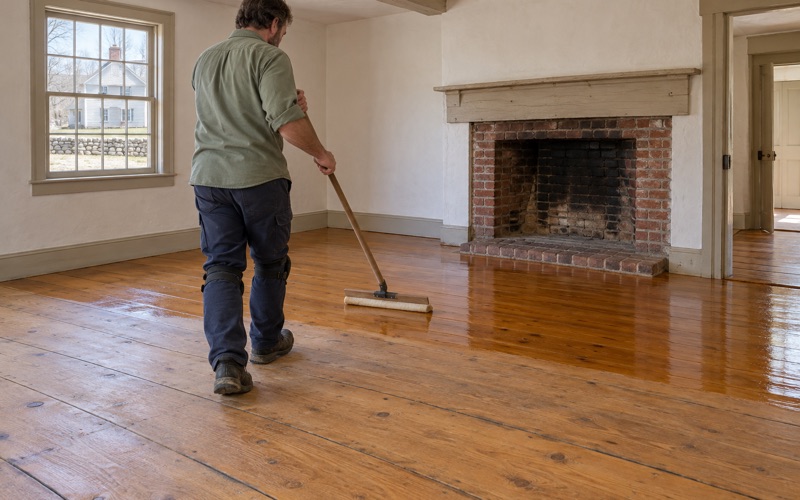
The finish itself has to fit Massachusetts limits on VOC content in wood coatings, which are tighter than the federal ones. On most older floors we choose between a waterborne polyurethane, which stays clearer and cures faster, and a hardwax oil that can be spot-repaired later without another full sanding. Floor stain, if you want one, goes on after water popping so the color takes evenly.
Parquet, Stairs and Patterned Work
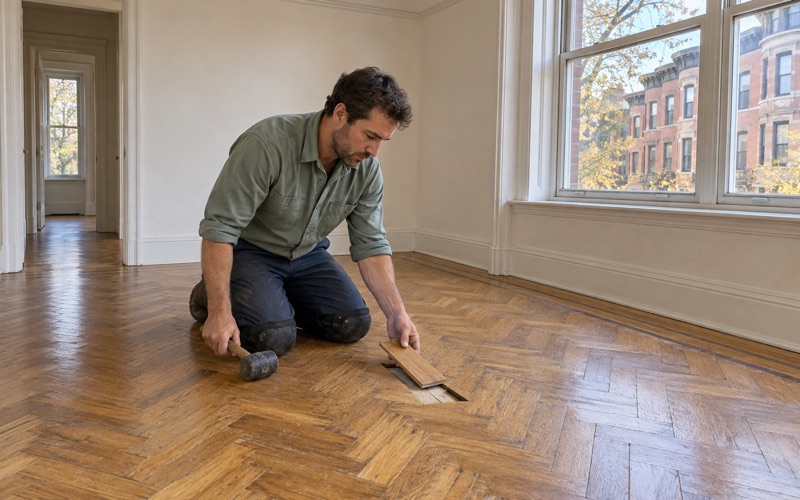
Where a pre-1950 room has parquet or a herringbone border, we treat it as a floor worth saving. Loose pieces are lifted, cleaned and re-glued one at a time, missing ones are cut to match, and the pattern is sanded with an orbital sander and hand work so the grain directions do not tear out.
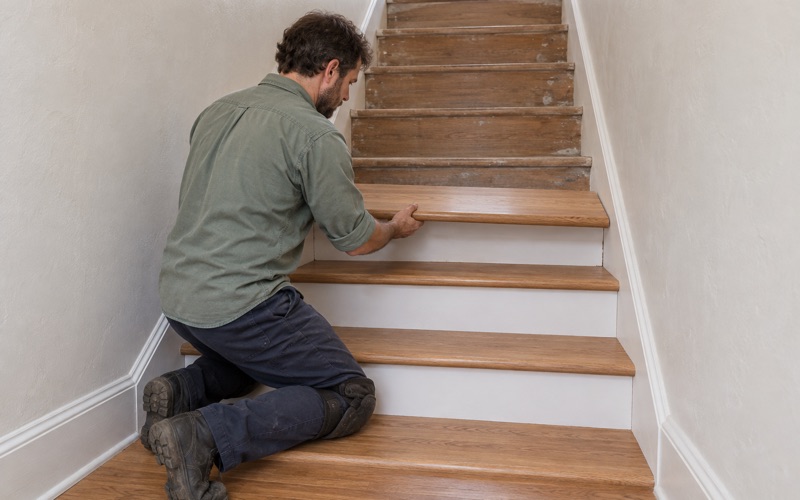
Stairs in older houses tend to show the most wear, with rounded nosings and treads worn hollow down the middle. We price them by the tread and riser rather than folding them into the square-foot figure for the rooms, because each step is sanded, edged and finished by hand. Painted risers go through the same lead check as the trim.
Looking for wood-flooring closer to Chelsea? See Wood-Flooring Services in Chelsea.
Interior Floor Work and Wellesley’s Historic Rules
Wellesley has two kinds of historic review, and neither one reaches a floor sanding. The first is Article 46C, the Historic Preservation Demolition Review Bylaw adopted at the 2017 Annual Town Meeting and administered by the Wellesley Historical Commission. It applies to dwellings constructed on or before December 31, 1949 when an owner plans to demolish the house, entirely or by removing or enveloping 50 percent or more of the existing exterior structure.
What the Demolition Delay Covers
If the Commission finds the building Preferably Preserved, demolition can be delayed by up to 12 months. The town is explicit that interior work is not subject to this review, so refinishing, board repair and replacing a worn floor inside a pre-1950 house sit outside it. Other town requirements for floor work are a separate question for the Town of Wellesley Building Department.
That matters when a family is deciding between keeping an older house and replacing it. Restoring the floors of a pre-1950 house is one of the ways to update it without touching the exterior work that the bylaw watches, and we are glad to assess the boards before that decision is made rather than after.
The Cottage Street Historic District
The second kind of review belongs to the Wellesley Historic District Commission. Wellesley created the Cottage Street Historic District in 1980 to preserve the houses occupied by workers in the town’s nineteenth-century shoe manufacturing, and it takes in 65 properties on Cottage Street, Washington Street, Abbott Street, Waban Street and Weston Road, just outside Wellesley Square.
Under M.G.L. c.40C, the Commission reviews alterations to exterior architectural features, meaning the parts of a building open to view from a public street, way, park or body of water. Floors are inside the house, so our work in these shoe workers’ houses is the same careful refinishing and board matching we do anywhere else in town. If a project also changes something visible from the street, that part is the Commission’s to review, and we flag it early.
Floors in Wellesley Houses Built Since 2000
The other end of the housing stock is new. The same ACS table counts 1,811 units, or 19.3 percent, built in 2000 or later, including 910 from 2010 to 2019 and 314 from 2020 on. New single-family houses whose proposed living area plus garage space exceeds the district threshold go through Large House Review under Section XVID of the Zoning Bylaw, which requires Wellesley Planning Board approval before the building permit is issued.
Engineered Floors and the Wear Layer
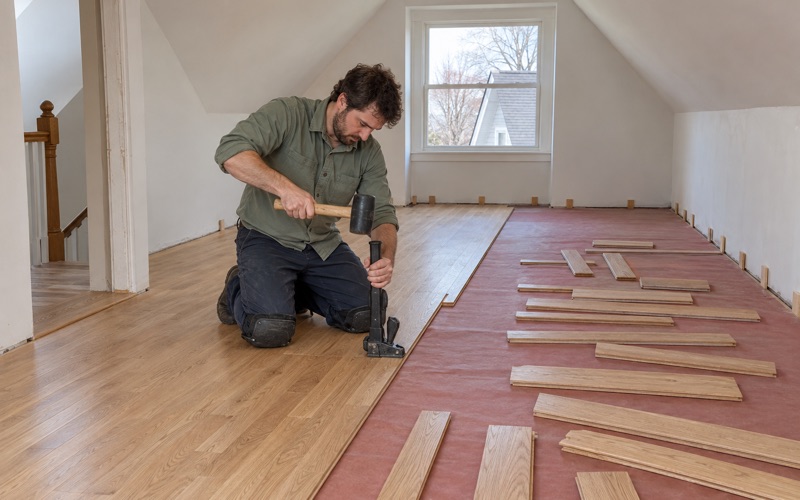
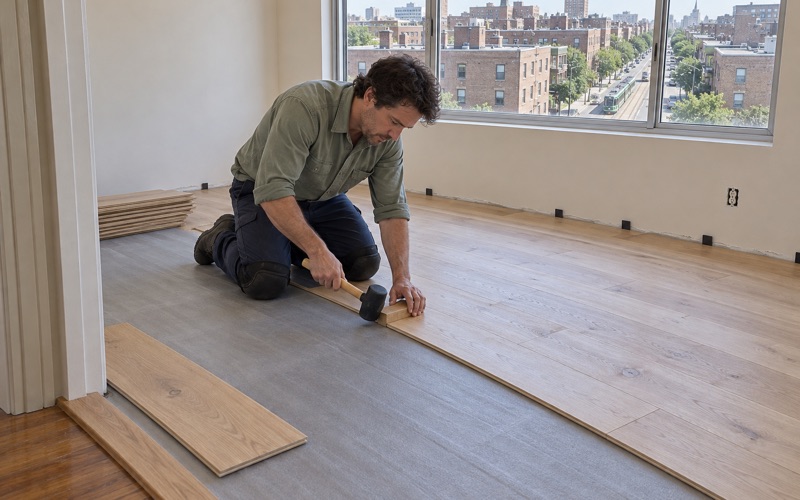
Newer houses may carry prefinished engineered flooring rather than site-finished solid hardwood, and that changes what a refinish can be. Before we promise a sanding on an engineered floor, we measure the wear layer above the plywood core, because a thin one may only take a screen and recoat. On solid tongue and groove floors, a light buff and fresh coat every few years usually keeps a full sanding a long way off.
Recoats Before the Wear Shows
A first recoat on a newer floor is short work compared with a restoration. The surface is cleaned and abraded with a buffer, checked for any contamination that would stop new finish from bonding, and given a fresh coat that matches the existing sheen level. Most rooms are back in use far sooner than after a full sanding, and the written cure schedule says exactly when.
Timing matters more than it looks. A recoat only works while the existing finish is intact; once traffic lanes wear through to bare wood, the graying wood in those paths needs sanding to even out, which on an engineered floor spends wear layer that cannot be replaced.
Seasonal Gaps and Moisture in Newer Floors
Floors in new houses move, and the first few heating seasons show it. Winter gaps that close again by summer are normal seasonal movement, while buckling or boards lifting at the walls usually point to a missing expansion gap or moisture the floor took on before or after it was laid. We read the boards and the subfloor with a moisture meter before calling it either way.
Planning a Floor Project in Wellesley
Wellesley is largely a town of owner-held detached houses. Of 9,174 occupied units, 7,742, or 84.4 percent, are owner-occupied, and 82.4 percent of all units are one-unit detached houses, so we plan most jobs around a household that is still living in the house.
Sequencing Rooms and Containing Dust
We split a whole-house job into stages so bedrooms, a kitchen path or a staircase stay usable while other rooms are sanded and cured. Dust containment goes up before the first pass, sanding runs through a HEPA vacuum system, and the cure schedule states when light foot traffic, furniture and area rugs can each return. Rugs are the last thing back, since a fresh finish needs longer before it is covered than before it is walked on.
Units in Larger Buildings
Not every Wellesley job is a detached house. The census also counts 336 units in buildings of 20 to 49 units and 389 in buildings of 50 or more, and in those we confirm any association’s flooring rules, work hours and elevator booking before a date is set. When the floor sits over a neighbor, the underlayment is chosen with the building’s rug-coverage or sound rules in mind.
Leaks and Water Stains
Water-damaged floors get their own sequence. A leak under a steam radiator or from a bathroom above is traced and stopped first, the boards are dried and read with a meter before anything is replaced, and we document the damage room by room for your insurance adjuster. Water stains that stayed in the finish often sand out, while gray or black staining that reached the wood usually means a weave-in repair.
Weather and Scheduling
Wellesley sits in the National Weather Service’s Western Norfolk forecast zone, MAZ013, and like the rest of the region it swings between dry, heated winter air and humid summers. We let new boards acclimate in the rooms where they will be laid, and we time sanding and finishing so the cure is not fighting the wettest or driest stretch of the year when a household has a choice.
Whether the house is in Wellesley Hills, The Fells or Wellesley Farms, the first step is the same walk-through. We look at the floor, the build year and the rooms around it, then send a written scope with the finish, the stair count and the schedule so you can plan the weeks ahead.
- 20+ Years on Wood Floors
- Free In-Home Estimates
- Dust-Contained Sanding