Brookline Wood Flooring brings more than 20 years of work to wood-flooring in Weymouth Town, and much of what we do here happens inside apartment buildings rather than single houses. We sand, repair, refinish and install solid and engineered floors, and we plan each job around who lives above and below the room. That shapes the underlayment, the schedule and the finish long before a sander is switched on.
A floor in a rented unit usually has a short window between tenants, so we price and schedule for that window. We quote refinishing, board replacement, stair work and full installations as separate lines, and stairs are always priced by the tread and riser. Owners get a written cure schedule with the quote, which tells them when the unit can be shown, cleaned and moved into.
Houses get the same care on a different clock. Before any sanding we check the build year and look for painted surfaces, since Massachusetts sets its own lead-safe renovation rules for homes built before 1978. Where original oak, maple or pine is still down, we repair and match those boards instead of tearing them out.
Floors in Weymouth’s Apartment Buildings
Weymouth has 26,733 housing units, and a large share of its rental housing sits in larger buildings. Census figures from the ACS 2024 5-year estimates show 6,134 of the town’s 8,388 renter households, or 73.1 percent, living in buildings of five or more units. Renters occupy 32.6 percent of the town’s occupied homes, so this is a steady part of the floor work here and not an occasional job.
Buildings of Fifty or More Units
The biggest buildings carry a surprising amount of that rental stock. In all, 2,414 renter households live in buildings of fifty or more units, and 3,726 of the town’s housing units sit in buildings that size. In buildings that large, the practical questions come first: where the elevator is, when we may run equipment and how dust leaves the floor.
We confirm the association’s or manager’s flooring rules, permitted work hours and elevator booking before a unit goes on our calendar. Dust containment matters more when a corridor is shared, so we seal the unit’s doorway and run HEPA vacuum extraction on the sanders. The goal is a hallway that looks the same on the day we leave as on the day we arrived.
Working Over a Neighbor
Any floor with a unit below it is also a ceiling. Many buildings set rug-coverage or sound rules, and we choose acoustic underlayment with those rules in mind when a new floating or glue-down floor goes in over a neighbor. We read the building’s own requirements rather than assuming a standard, because they differ from one association to the next.
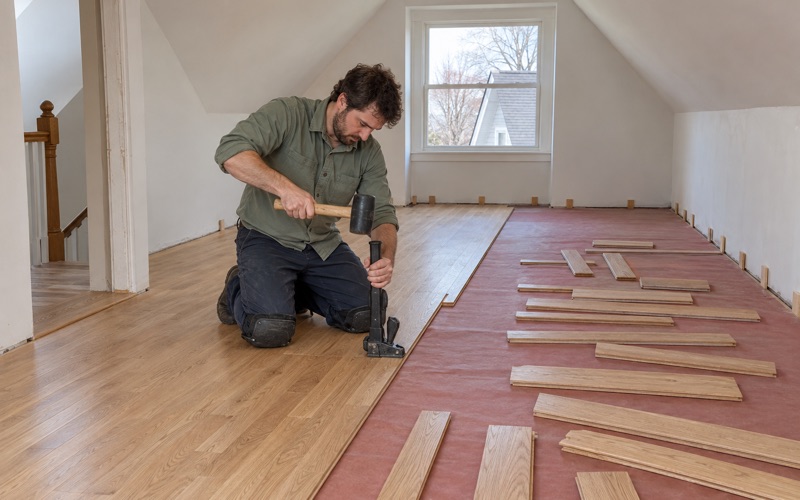
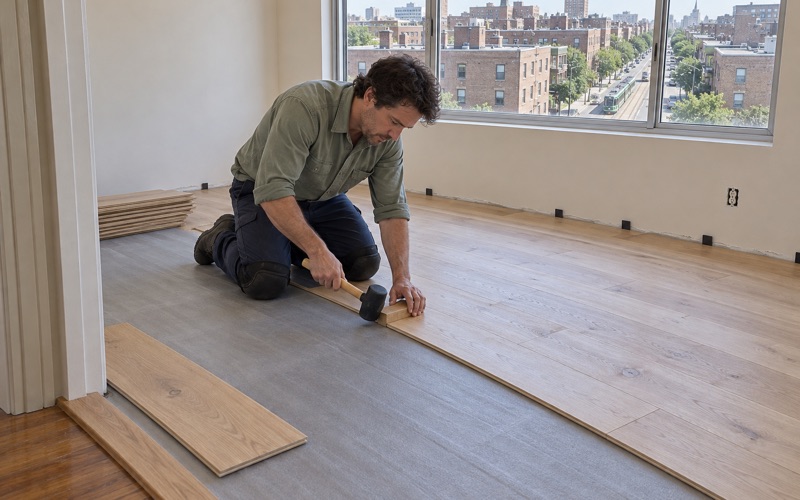
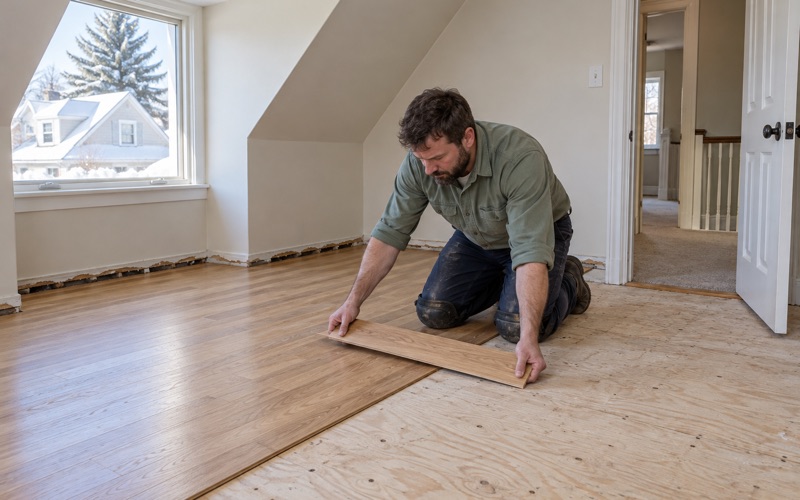
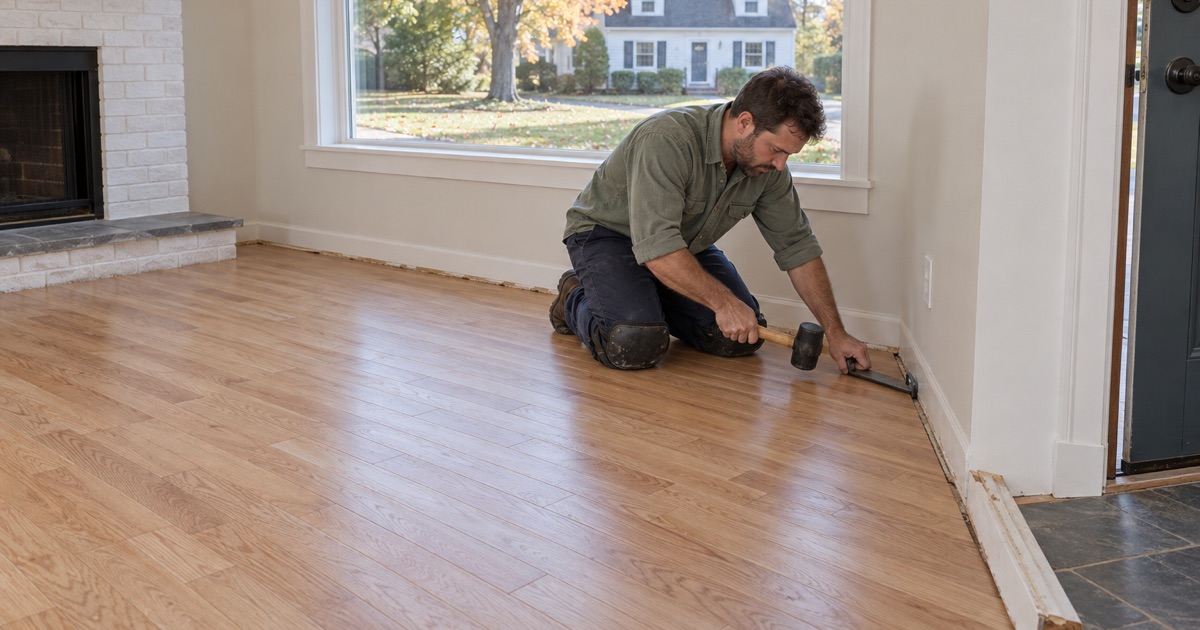
Nail-down installation over a plywood subfloor behaves differently from a floating floor laid over a concrete deck, and we explain that choice in plain terms. Expansion gaps at the walls, a proper reducer or threshold at each doorway and fresh quarter round finish the job. Those details are what stop buckling and edge gaps a year later.
Owners in the Same Buildings
Not every unit in these buildings is a rental. The census also counts 2,119 owner households in buildings of five or more units, and an owner planning a long stay often wants a different result than a landlord between leases. An owner may choose a site-finished red oak or white oak floor with a chosen stain and sheen level, where a landlord may favor a durable prefinished plank.
For engineered floors, we measure the wear layer before promising a sanding. Some engineered planks carry enough top veneer for a full sand and refinish, while thin ones can take only a screen and recoat. Knowing which one you have before work begins saves a surprise halfway through the job.
Looking for wood-flooring closer to Wakefield? See Wakefield Wood-Flooring.
Turning Over a Rental Unit’s Floors
Weymouth’s census counts also show how units change hands: of 974 vacant units, 238 were for rent and 127 were rented but not yet occupied. Those counts describe the small gap in which most rental floor work happens. We plan turnover jobs to fit inside that gap, with the finish cure written down so the next move-in date holds.
Reading the Floor Between Tenants
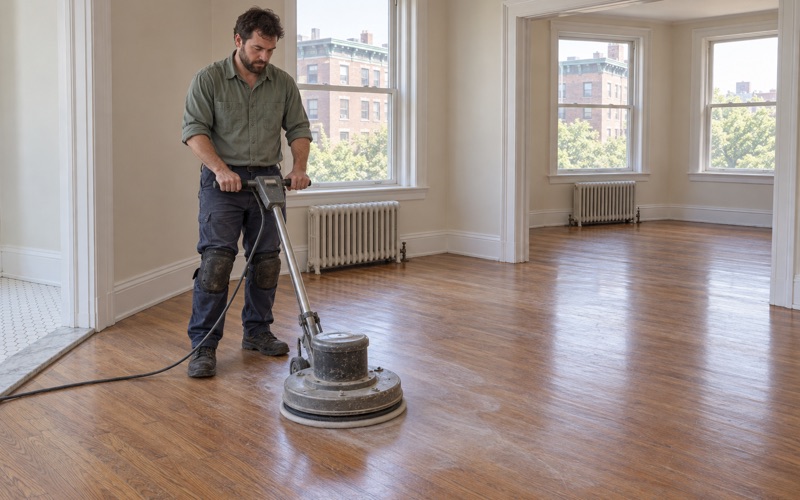
Between tenants we walk the floor and sort it into three likely answers. A floor with a worn but intact finish can often take a screen and recoat with a buffer, while gray traffic lanes and scratches through to bare wood call for a full sanding. Loose boards, hollow spots and wide board gapping point to repairs before any finish goes down.
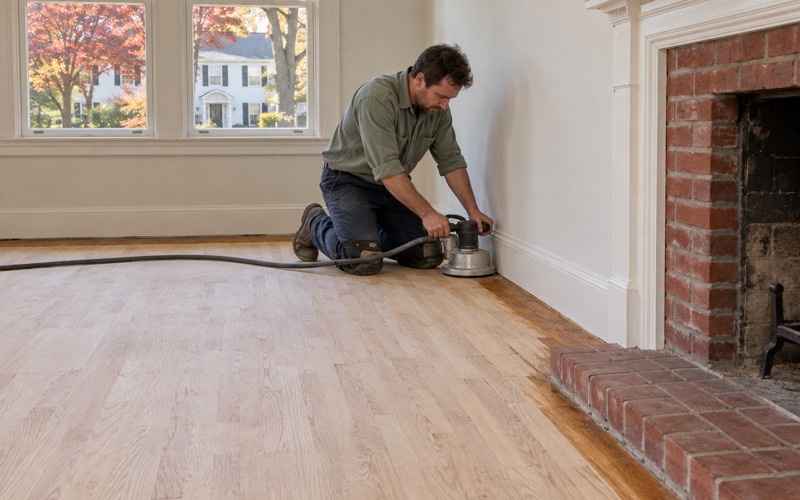
When a full sand is needed, we work through a grit sequence with a drum sander on the field and an orbital sander at the edges. Stain choices are tested on the actual floor, and water popping helps a darker floor stain take evenly. A consistent color across units makes a building easier to rent and easier to maintain.
Stains, Pets and Leaks
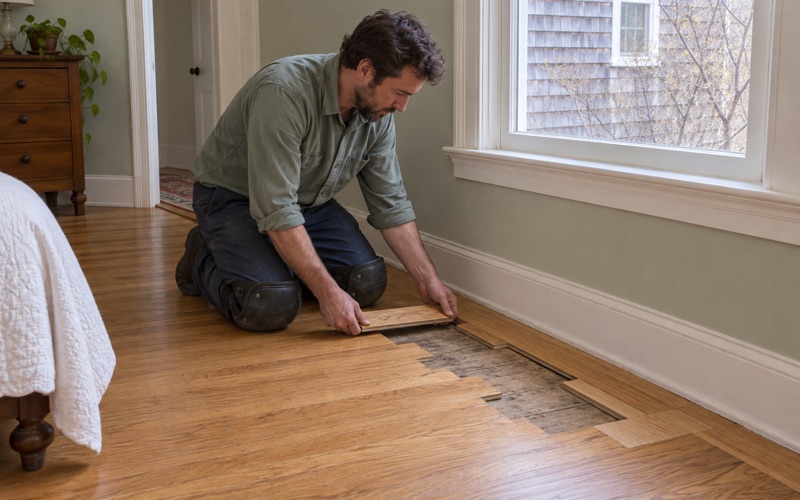
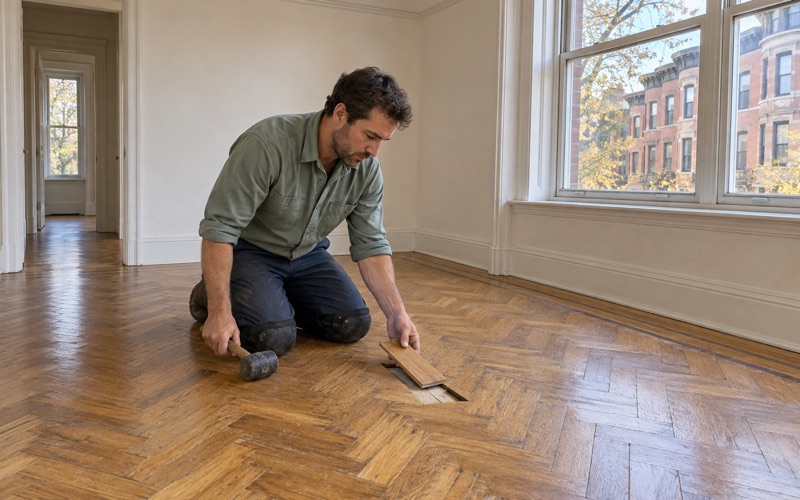
Pet urine stains and water stains are common findings when a unit is emptied. Surface marks often sand out, but a dark stain that runs deep into the wood usually means board replacement with a weave-in repair so the new boards blend with the old. We explain which boards are being cut out and why before the work starts.
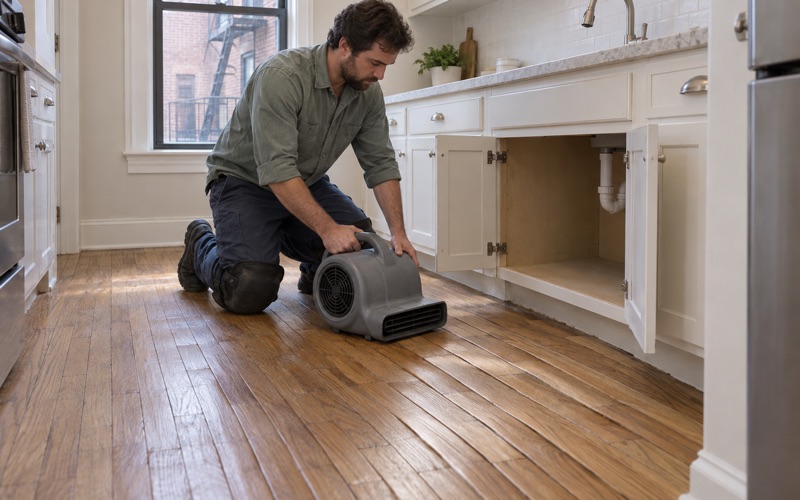
In a stacked building, a stain can also come from above. When a radiator or an upstairs unit has leaked, we find the source, dry the boards and read them with a moisture meter before replacing anything. If an insurance claim is open, we document the damage room by room for the adjuster.
Finishes and a Written Cure Schedule
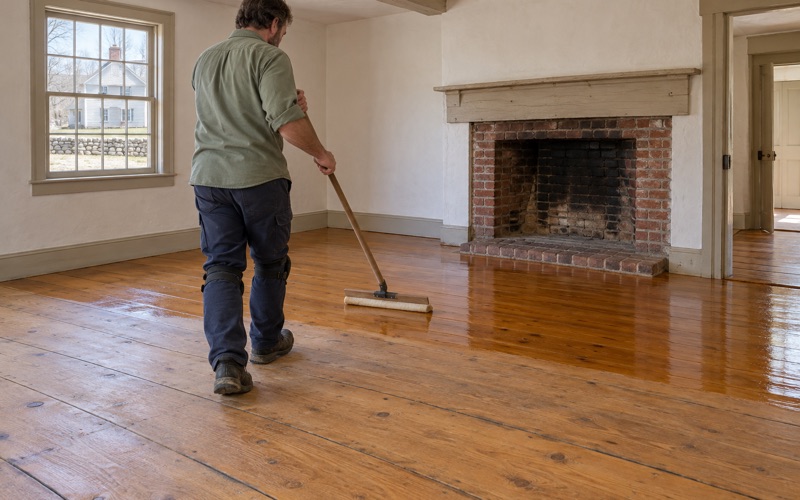
Finish choice matters in a unit that has to be ready quickly. Waterborne polyurethane dries faster and carries less odor than an oil-modified polyurethane. Every finish we use is chosen to fit the Massachusetts limits on VOC content in wood coatings, which are stricter than the federal ones.
Each turnover comes with a written cure schedule showing when the floor can take light foot traffic, when furniture can return and when rugs can go down. Property managers can then book cleaners and move-ins against real dates. A floor that is rushed tends to show dents and rug marks within weeks.
Village Houses and the Postwar Build-Out
Outside the apartment buildings, detached houses make up most of Weymouth’s housing, with 14,835 of the 26,733 units counted as one-unit detached. They are spread across four village centers: North Weymouth, South Weymouth, East Weymouth and Weymouth Landing. Settled in 1622, Weymouth is the second-oldest settlement in Massachusetts, and its housing ages reflect that long history.
Houses Built Before 1940
The single largest age bucket in the census is 1939 or earlier, with 5,799 units, or 21.7 percent of the housing stock. In houses of that age we look for board-by-board wear, older finishes and signs of powderpost beetle or carpenter ants in boards near an exterior wall. Our approach is to repair and match original boards wherever they are sound.
Older houses also bring the lead question. Paint on baseboards, stair risers and old finishes may predate 1978, so we confirm the build year and check painted surfaces before we sand. The Massachusetts Lead Law and the state’s lead-safe renovation rules decide how that work must be done, and we plan dust control around them.
The 1950s Surge
Weymouth grew quickly after the war, from 32,690 people in 1950 to 48,177 in 1960. The census counts 4,352 housing units built from 1950 to 1959, the largest single decade in the count. When a house from that period has carpet over wood, we check for tack strip damage, staple holes and black mastic before quoting a refinish.
Pulling up old carpet usually shows what a floor needs. Tack strip holes along the walls take a matched wood filler, and staple holes across the field mostly disappear under sanding. Where black mastic remains from an old tile or carpet install, we assess it before any sanding, since old adhesives need care.
Stairs and Transitions
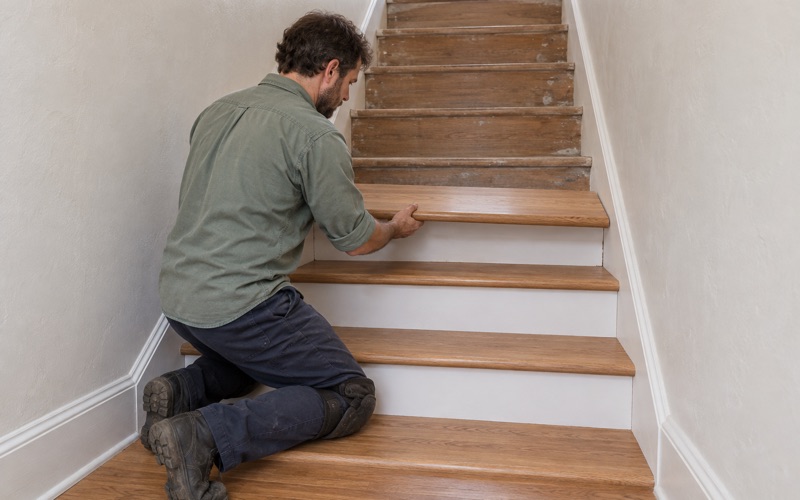
Where a house has a staircase, it is often the first place a floor shows wear. We quote stairs by the tread and riser rather than folding them into a square-foot price, and we can replace worn stair treads and stair nosing to match the floor above and below.
Newer Homes, Including Union Point
Weymouth’s newer housing is a smaller but real share of the town. The census counts 2,292 units built from 2010 to 2019 and 211 built in 2020 or later, and floors in newer homes need a different first look than a prewar house. Before anything else, we identify whether a floor is solid hardwood, engineered with a plywood core, or a floating product.
Engineered and Prefinished Floors
An engineered floor can be sanded only as many times as its wear layer allows. We measure that layer before promising a sanding, and when it is too thin we recommend a screen and recoat or targeted board replacement instead. Prefinished floors with factory finishes may also need a compatible recoat product, which we test on a small area first.
Newer floors show their own seasonal habits. Winter gaps open between boards when indoor heat dries the air, and cupping or crowning can follow summer humidity or a moisture problem below. We check acclimation, expansion gaps and moisture readings before calling any of it a defect.
Union Point on the Former Naval Air Station
Union Point is the 1,400-acre redevelopment of the former South Weymouth Naval Air Station, which closed in 1997. The site spans Weymouth, Rockland and Abington, and the SouthField Redevelopment Authority oversees it. Its master plan calls for 4,000 residential units, alongside 1,000 acres of open space and 50 miles of trails.
For homes there, we treat each floor as we would any newer home: identify the product, measure what it can take and plan finishes to suit. Owners in any association-managed home should expect us to check the association’s rules before scheduling, just as we do in older buildings.
Planning the Work
Every Weymouth job starts with a visit to look at the floor, the building and the access. We note the build year, the subfloor, any radiant heat or steam radiator locations and the route for equipment. From that visit we give a written quote that separates repairs, refinishing and stairs, so an owner or manager can decide one line at a time.
Weymouth sits in the Eastern Norfolk forecast zone, and indoor humidity shifts across the year here as it does across the region. We time finish work to steadier conditions when a schedule allows. The finish, the underlayment and the cure dates all go in writing before work begins.
- 20+ Years on Wood Floors
- Free In-Home Estimates
- Dust-Contained Sanding